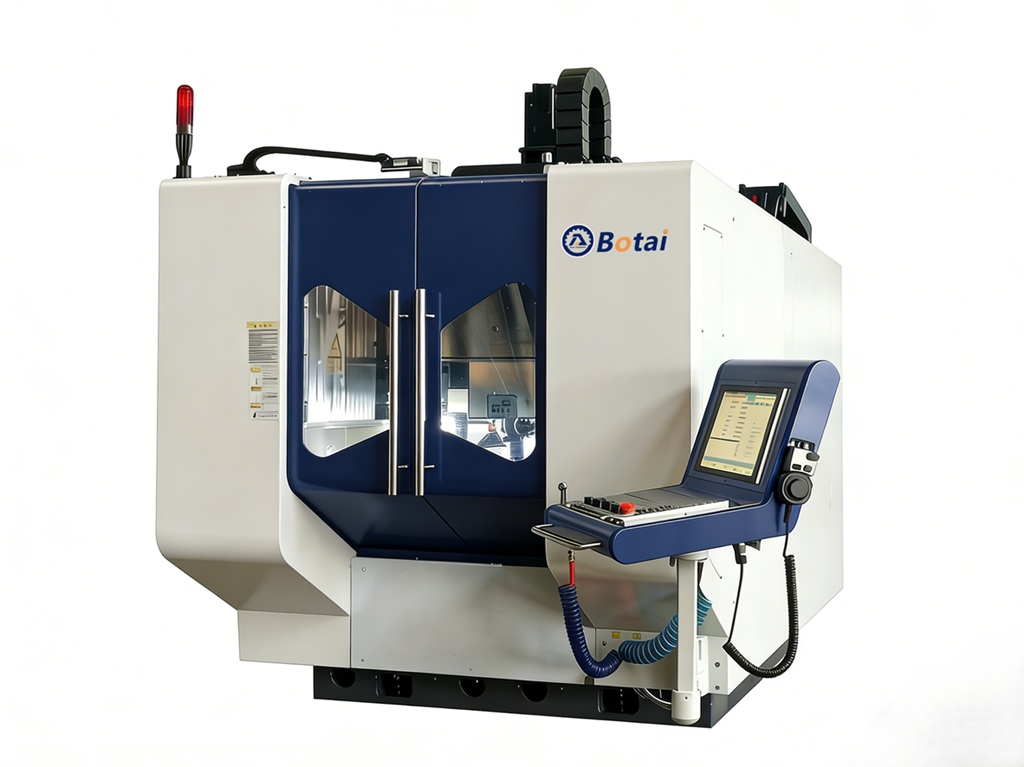
Choosing the right CNC lathe is one of the most consequential equipment decisions a machine shop will make. The machine you select today will determine what parts you can accept, how efficiently you can produce them, and how easily you can maintain the machine over the next decade. Yet many buyers focus on price or brand name while overlooking the three specifications that matter most: swing size, chuck type, and controller options.
This guide walks through each of these critical dimensions, helping you match the machine to your actual production reality — not just a catalog sheet.
What this guide covers
- Swing size: more than just a big number
- Chuck type: the interface between machine and part
- Controller options: the brain of the machine
- Vertical vs horizontal: when to choose each
- A selection framework
- Frequently asked questions
Swing Size: More Than Just a Big Number
When manufacturers list a lathe's capacity, they typically provide two figures: swing over bed and swing over carriage (sometimes called swing over cross slide). These numbers describe very different capabilities, and confusing them can lead to a machine that cannot handle your parts.
Swing over bed is the maximum diameter of a workpiece that can be rotated above the bed ways without hitting the bed structure. Swing over carriage is the maximum diameter that can be turned when the carriage is in the extended position — and it is almost always smaller than swing over bed.
A common mistake is selecting a lathe based solely on swing over bed. In practice, the swing over carriage determines what you can actually machine along the full length of a part. If your workpiece is long and you need to turn along its entire length, the carriage swing is the limiting factor.
This gap is not a rounding error — it is substantial. Look at how it plays out across real machine specifications:
| Model | Type | Swing over Bed | Swing over Cross Slide | Typical Application |
|---|---|---|---|---|
| BCF-30N | Flat-bed | 300 mm | 100 mm | Small parts, 4 kW spindle |
| BCS-36 | Slant-bed | 360 mm | 140 mm | Precision shafts, high-speed spindle |
| BCM-56 | Y-axis turn-mill | 560 mm | 280 mm | ±50 mm Y-axis, BMT55 power turret |
| BCH-80 | Heavy-duty horizontal | 800 mm | 540 mm | Batch turning, 15 kW spindle, 4-speed gear |
| Watch the gap On the BCH-80, swing over bed is 800 mm but swing over cross slide is 540 mm — a 32% reduction. If your part is 600 mm in diameter and you need to turn it along its full length, this machine will not do it, despite the "800 mm" figure on the spec sheet. Rule of thumb Allow 10–20% more swing capacity than your largest part diameter. This margin provides flexibility for future work, allows for safe clamping, and accommodates tooling that may extend beyond the workpiece. |
Chuck Type: The Interface Between Machine and Part
The chuck is where the workpiece meets the machine. Its type, size, and clamping method directly affect setup time, part accuracy, and the range of work you can handle.
Three-Jaw Universal Chucks
The most common choice in general turning. They are self-centering, meaning all three jaws move together, making them fast and repeatable for round and hexagonal workpieces. However, their gripping power is limited, and accuracy degrades as the scroll mechanism wears.
Four-Jaw Independent Chucks
Jaws adjust individually, offering maximum flexibility for irregular, square, or off-center workpieces and allowing precise centering using a dial indicator — often achieving higher accuracy than a three-jaw chuck. The trade-off is setup time: each jaw must be adjusted separately.
Collet Chucks
The production workhorse for bar work. They center accurately, hold tightly, and do not mark the workpiece surface, making them ideal for high-volume small-part production. A gang-type lathe built around a collet is often the most efficient way to turn thousands of small parts per week:
| BCT-36 |
|---|
| Small Gang-Type CNC Lathe |
| 36-type collet · Φ46 mm spindle through hole · 4,500 rpm · ±0.003 mm accuracy — built for efficient small-part turning |
Matching Chuck Size to Machine Class
The chuck size class — commonly 6", 8", or 10" — defines the machine's size band. An 8-inch (200 mm) chuck class typically corresponds to a maximum swing over bed of 300–500 mm and a maximum turning diameter of 200–360 mm. Choose a chuck size that comfortably grips your typical workpiece while leaving room for the spindle bore if you plan to use bar feeding.
Controller Options: The Brain of the Machine
The CNC controller determines how you program, how you recover from errors, and how easily you can find spare parts and trained operators. The two dominant platforms for CNC lathes are Fanuc and Siemens, each with distinct strengths.
Fanuc — Stability and the Largest Operator Pool
Fanuc (particularly the 0i-TF series) holds the largest installed base among CNC controls, and is known for exceptional stability and fast servo response. Its G-code programming is widely understood, post-processors are mature, and the operator pool is large. For production runs of 1,000+ parts with established programs, Fanuc is often the pragmatic choice.
Siemens — Conversational Speed for Job Shops
Siemens (such as the 828D with ShopTurn) excels in job-shop environments with frequent changeovers and smaller batches (under 50 parts per program). Its conversational programming and on-board animated simulation allow one-off programs to be created visibly faster. Siemens also offers stronger kinematics setup tools for complex multi-axis work.
The decisive factor
Often it is not the controller brand at all, but local support and operator familiarity. A controller your team already knows will deliver more productivity from day one.
Verify the exact generation
Before ordering, confirm the exact control model and generation. A "Fanuc control" on a spec sheet could mean anything from an older 0i-TC to a current 0i-TF Plus, with different capabilities and support lifecycles. Run the actual contours and operations you plan to machine on the quoted configuration — not on a different showroom machine.
Vertical vs Horizontal: When to Choose Each
Swing, chuck, and controller are the three specifications buyers most often get wrong — but there is a fourth decision that sits upstream of all of them: machine orientation.
Horizontal lathes are the default for shaft-type work. Long parts, bar feeding, and general turning all favor a horizontal bed, because gravity helps rather than hinders chip evacuation and part loading.
Vertical lathes (also called vertical turning lathes) shine on large-diameter, short-length, heavy disc-type parts — brake drums, flywheels, flanges, valve bodies. Workholding is far easier because the part sits flat on a horizontal table instead of being clamped vertically, and the load is supported directly by the table rather than by a chuck fighting gravity.
If your part family is disc-shaped and awkward to clamp in a horizontal chuck, a vertical machine will often pay for itself in setup time alone:
| BCV-50S |
|---|
| Small Single-Column CNC Vertical Lathe |
| 500 mm max. swing diameter · 400 mm max. turning diameter · 11/15 kW spindle · 8-station turret — efficient turning for small discs |
For larger disc work, the same architecture scales up considerably — see the BCV-12H single-column vertical lathe, which handles up to 1,400 mm swing diameter and 4-ton workpiece loads.
A Selection Framework
Bringing the four dimensions together into a repeatable process:
- Start with your part family. Identify the largest diameter and longest length you need to turn. Do not size on your average part — size on your worst-case part.
- Add 10–20% margin to both swing and turning length. This is your future-proofing buffer.
- Check swing over carriage, not just swing over bed. If your parts are long, the carriage figure is the one that governs.
- Choose the chuck type that matches your workholding: collets for bar work, three-jaw for general round parts, four-jaw for irregular shapes.
- Decide horizontal or vertical based on part geometry — shaft-type work favors horizontal, heavy disc-type work favors vertical.
- Select the controller based on operator familiarity, local service availability, and the programming workflow that suits your batch sizes.
Frequently Asked Questions
What is the difference between swing over bed and swing over carriage?
Swing over bed is the maximum diameter of a workpiece that can rotate above the bed ways without hitting the bed structure. Swing over carriage (also called swing over cross slide) is the maximum diameter you can actually turn with the carriage engaged, and it is always smaller. On a Botai BCH-80 heavy-duty lathe, for example, swing over bed is 800 mm but swing over cross slide is only 540 mm.
How much swing capacity margin should I allow when sizing a CNC lathe?
Allow 10–20% more swing capacity than your largest part diameter. This margin provides flexibility for future work, allows safe clamping, and accommodates tooling that may extend beyond the workpiece.
Fanuc or Siemens — which CNC controller should I choose for a lathe?
Fanuc (such as the 0i-TF series) suits production runs with established programs thanks to its stability, mature post-processors, and large operator pool. Siemens (such as the 828D with ShopTurn) suits job shops with frequent changeovers and batches under 50 parts, thanks to conversational programming and on-board simulation. The decisive factor is usually local service support and operator familiarity.
Which chuck type is best for bar work and high-volume small parts?
Collet chucks are the production workhorse for bar work. They center accurately, hold tightly, and do not mark the workpiece surface. The Botai BCT-36 gang-type CNC lathe uses a 36-type collet with a Φ46 mm spindle through hole for exactly this kind of high-volume small-part turning.
Can I turn long shafts on a standard CNC lathe?
It depends on swing over carriage and turning length, not swing over bed. If your workpiece is long and you need to turn along its entire length, the carriage swing is the limiting factor. Always size the machine on swing over carriage when long parts are involved.

 Related News
 Related Products