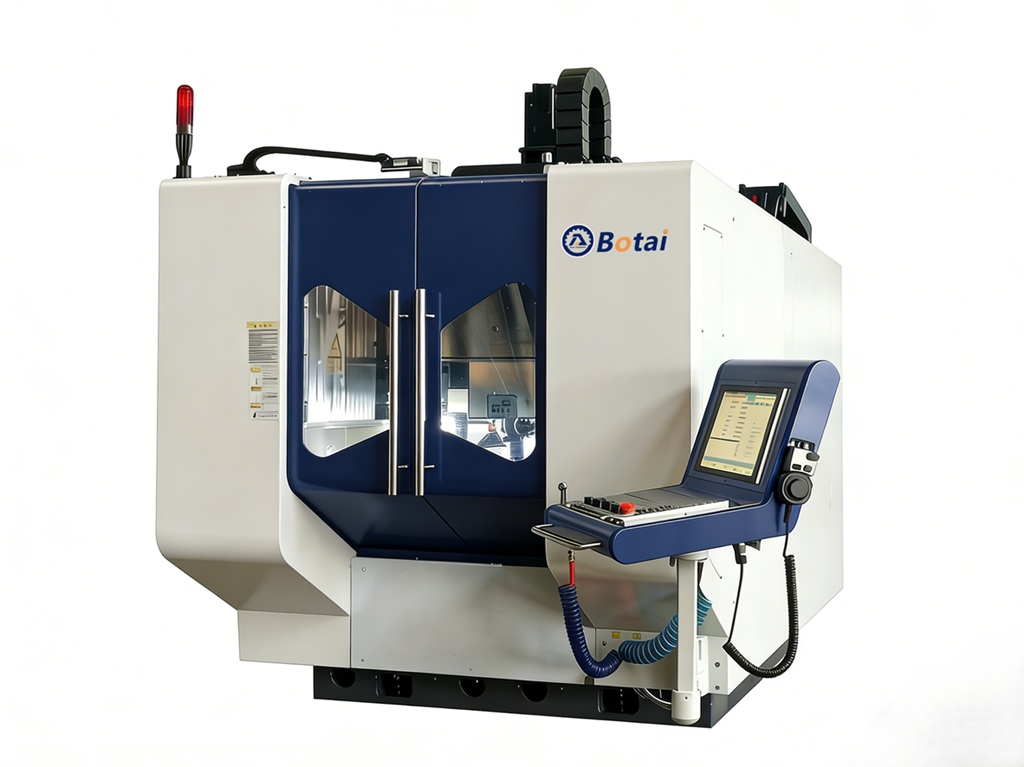
A bandsaw is the cheapest machine tool in the workshop and the one most often bought on a single number. The buyer compares "maximum cutting diameter", picks the model that clears the biggest bar in the rack, and discovers six months later that the same machine cannot mitre at 45°, cannot take a bundle of channel, and eats a blade a month because the low speed setting is still too fast for the stainless work that turned out to be half the order book.
The problem is not the machine. It is that cutting capacity is a three-dimensional envelope, not a single figure, and the envelope shrinks as soon as you change the angle, the material or the way the work is clamped. This guide works through that envelope the way we do when specifying a saw for a customer — from the cut back to the machine.
The short answer
- Capacity: record round diameter, square width and height separately, then check capacity at the angle you actually cut. A swing-arm saw can lose half its round capacity between 90° and 60°.
- Structure: swing-arm for mixed small work and mitres, dual-column for thick straight cut-off, vertical for plate and large awkward sections.
- Blade: width sets rigidity and straightness; tooth pitch sets what thickness it can cut without snagging. Both must match the job.
- Speed range: a two-speed saw starting at 40 m/min is a carbon-steel saw. Stainless and tool steel need a low range around 20–30 m/min.
- Automation: the break-even is roughly 100 cuts per shift on a consistent section. Below that, semi-automatic is more flexible.
In this guide
- Start with the cut, not the machine
- Reading cutting capacity correctly
- Swing-arm, dual-column or vertical
- Bandsaw or circular saw
- Semi-automatic versus automatic
- Blade selection: width, TPI and material
- Motor power and cutting rate
- Remnant length and material yield
- The selection sequence, in order
- Six specification mistakes that cost real money
- Frequently asked questions
1. Start with the cut, not the machine
Bandsaw selection is a derivation from the workpiece. Before looking at any catalogue, write down six numbers about your work. A supplier who quotes a model without asking for these is guessing, and the guess will be wrong in one of the expensive directions.
| What to record | What it drives | How to get it right |
|---|---|---|
| Largest section height | Cutting capacity | The vertical dimension of the workpiece as it sits in the vice. This is the real limit — not the round diameter in the brochure. |
| Largest section width | Cutting capacity | Matters for plate, wide flats and bundled sections. A saw can be deep enough and still too narrow. |
| Most common cutting angle | Structure and capacity at angle | If 80% of your cuts are square, size at 90°. If you mitre structural steel daily, size at 45° and accept the reduction. |
| Material mix and hardest grade | Blade, speed range, coolant | Stainless, tool steel and high-strength alloys need low blade speed and higher feed pressure. One grade of stainless in the mix changes the speed requirement. |
| Cuts per shift and per setup | Automation level | Count actual cuts, not parts. A part that needs four cuts is four cuts of machine time. |
| Shortest cut length | Remnant loss and bar feed | Short repetitive cuts on an automatic saw are dominated by remnant length and index time, not by cutting speed. |
Cut audit worksheet — the six inputs that determine capacity, structure, blade and automation level.
One further number deserves a line of its own: the weight of the heaviest workpiece you will physically load. A 330 mm solid steel bar is roughly 670 kg per metre. Loading it by crane onto a saw with a 750 kg net machine weight is a different proposition from loading 20 kg tube by hand, and it affects whether you need a roller table, a loading magazine or a different structure altogether.
2. Reading cutting capacity correctly
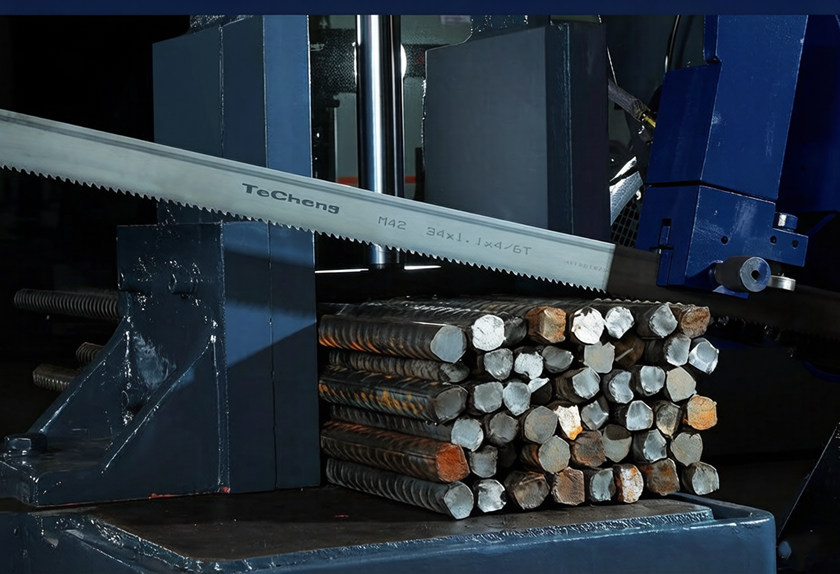
Cutting capacity is where most of the money is lost, because the number in the brochure is almost always the best case: round bar, cut square, blade new, vice in its most favourable position.
Round diameter is not the limit — height is
A horizontal bandsaw cuts by feeding the blade down through a stationary workpiece. What constrains it is the distance between the blade and the bed, and the throat between the guides. A round bar uses that height efficiently because its width equals its height. A rectangular section does not.
Look at three swing-arm models side by side and the pattern is obvious:
| Model | Round at 90° | Square at 90° | Height ratio |
|---|---|---|---|
| BSE-280 | Φ220 mm | 250 × 155 mm | 0.70 |
| BSE-315 | Φ230 mm | 315 × 170 mm | 0.74 |
| BSE-460 | Φ330 mm | 460 × 250 mm | 0.76 |
Swing-arm capacity envelope at 90°. The square-section height is consistently 70–76% of the round diameter — that is the number to compare against your tallest workpiece.
This is not a manufacturing limitation, it is geometry. The saw can accept a 250 mm wide rectangle, but only 155 mm tall, because the blade has to complete its travel above the bed. If your work is 200 mm tall H-beam, the BSE-280 is not a 220 mm machine for that job — it is a 155 mm machine, and it will not do it. The BSE-460 at 250 mm height will.
The sizing rule that prevents most returns
Compare your tallest workpiece against the square-section height, not the round diameter. Then compare your widest workpiece against the square-section width. Only after both pass should you look at the round figure.
Capacity collapses as the angle increases
On a swing-arm saw the head pivots about a point, so the further it swings from vertical, the less of the bed it can reach. The same BSE-280 that cuts Φ220 at 90° cuts Φ160 at 45° and only Φ100 at 60°:
| Angle | Round | Square | Share of 90° capacity |
|---|---|---|---|
| 90° | Φ220 mm | 250 × 155 mm | 100% |
| 45° | Φ160 mm | 160 × 110 mm | 73% |
| 60° | Φ100 mm | 80 × 95 mm | 45% |
BSE-280 capacity by angle. A saw sized for a 200 mm bar at 90° cannot mitre that same bar at 45°.
This single table explains a large share of "the machine is too small" complaints. The buyer had a Φ180 bar and a regular 45° mitre. The saw was specified at Φ220, which looked like a comfortable margin, and it cannot do the job — because at 45° the capacity is Φ160.
If mitring is a routine part of your work rather than an occasional favour, size the machine from the angle capacity and accept that you are paying for unused capacity at 90°. That is cheaper than buying twice.
Dual-column saws behave differently
A dual-column saw does not pivot. The head travels vertically on two columns and the blade feeds horizontally through the work, so the capacity envelope is closer to a true rectangle. On a BSH-35S the rating is 350 × 350 mm in both width and height, against Φ330 round on the swing-arm BSE-460. For tall square and structural work the dual-column layout is the more efficient use of the same footprint.
| Model | Structure | Capacity | Blade | Main motor |
|---|---|---|---|---|
| BSH-28S | Dual-column, semi-automatic | 280 × 280 mm | 27 × 0.9 × 3505 mm | 2.2 kW |
| BSH-35S | Dual-column, semi-automatic | 350 × 350 mm | 34 × 1.1 × 4115 mm | 3 kW |
| BSV-40 | Vertical, sliding carriage | 400 × 400 mm | 41 × 1.3 × 5000 mm | 3 kW |
Dual-column and vertical models. Note how blade width rises with capacity — 27 mm, 34 mm, 41 mm — because a wider blade is what keeps a deep cut straight.
3. Swing-arm, dual-column or vertical
Three structures cover almost all metal cut-off work, and the choice is driven by the shape of the workpiece and the mix of jobs, not by capacity alone.
Swing-arm (pivot) saws
The head pivots on a hinge and swings down through the work. This is the classic general-purpose workshop saw: simple, inexpensive, and — critically — the easiest type to set for mitre cutting, because the head rotates rather than the vice or the workpiece.
Best for: mixed small-to-medium bar and tube, fabrication shops that mitre regularly, job shops with varied work, workshops where one saw has to do everything.
Weak at: tall sections (the height ratio penalty above), high-volume repetition, and thick hard material where head rigidity matters.
BSE-280 Horizontal Metal Band Saw
Φ220 mm round / 250 × 155 mm square at 90°, Φ160 mm at 45°. 27 × 0.9 × 2450 mm blade, 0.75/1.1 kW, gear drive, hydraulic clamping.
Dual-column saws
The head is guided on two columns and moves vertically, with the blade feeding horizontally. The structure is far more rigid than a pivoting head, which is why dual-column saws dominate thick-section and hard-material cut-off.
Best for: solid bar over 200 mm, die steel and mould plate, billet, heavy structural sections, and any job where straightness of cut matters.
Weak at: mitre work (some models mitre by swinging the vice, which is slower to set), and price — the structure costs more for the same nominal capacity.
Blade width is the tell. A BSH-35S runs a 34 × 1.1 mm blade where a swing-arm saw of similar round capacity runs 27 × 0.9 mm. The wider, thicker blade resists bending through a deep cut, which is exactly what a 350 mm tall workpiece demands. A narrow blade in a deep cut wanders, and a wandering blade produces a curved face that has to be machined off afterwards — a hidden cost that shows up in the milling department, not the saw department.
Practical check
Ask for the blade dimensions before the capacity figure. If a saw rated for 350 mm depth runs a 27 mm blade, it will cut 350 mm — but not straight, and not for long. Blade width and thickness are a more honest indicator of structural seriousness than the nominal capacity.
Vertical saws
The workpiece is clamped to a table or carriage and moved into a stationary vertical blade, or the blade is guided down a sliding carriage. Vertical saws are for plate, large flanges, mould blocks and shapes that cannot be held in a horizontal vice.
Best for: plate cut to shape, large flange blanks, mould steel plate, box weldments, and any workpiece where the cut line is not a simple cross-section.
Weak at: repetitive bar cut-off — the manual handling per cut is high and the automation options are limited.
The BSV-40 illustrates the trade-off clearly: 400 × 400 mm capacity, a 41 × 1.3 × 5000 mm blade and 3 kW, on a machine built around a hydraulic vice and sliding carriage rather than a bar feed. It will take a 400 mm plate block that no horizontal saw in the same price bracket will touch, but it is not the machine you want for cutting 500 pieces of Φ30 bar to length.
4. Bandsaw or circular saw
For small sections in volume, a circular saw can be the better buy — and buyers who only compare bandsaws never see the option. The two technologies have almost opposite strengths.
| Criterion | Bandsaw | Circular saw |
|---|---|---|
| Section range | Very wide — from 20 mm tube to 400 mm billet | Limited — typically up to Φ55–110 mm depending on model |
| Cutting speed | Slow. A 200 mm solid bar is minutes, not seconds | Fast. Often 3–5× the cut rate on small sections |
| Cut face quality | Good, usually needs a facing pass for tight tolerance | Excellent. Burr-free faces, often ready to machine |
| Length accuracy | Good with a powered stop, ±0.2 mm typical | Excellent. Servo feed holds ±0.05 mm |
| Consumable cost | Low per cut. Blades are inexpensive and long-lived | High per cut. A carbide-tipped blade is a significant item |
| Bundling and profiles | Excellent. Cuts bundles of tube and sections in one pass | Poor. Needs single pieces and stable clamping |
| Best application | General cut-off, large sections, mixed work, structural steel | High-volume small bar, precision blanks, near-net cut lengths |
Bandsaw versus circular saw. The decision is driven by section size and volume, not by which is "better".
The numbers on a real machine make the case. A BSY-55X slant-feed circular saw cuts Φ10–55 mm round and 10–35 mm square, holds ±0.05 mm feeding accuracy, indexes 550 mm per stroke and leaves a remnant of 70 mm plus the cut length. It runs a 250 mm blade at 110–200 rpm with 1.5 kW hydraulic power.
That is a very specific machine: small bar, high accuracy, high volume. Put it against a BSE-315 cutting the same Φ30 bar and the circular saw will be several times faster with a better face — but it cannot cut the Φ180 billet that the same workshop also needs to process twice a week. This is why many shops end up with both, and why the first purchase should match the dominant job rather than the widest capability.
Decision rule
If more than about 70% of your cuts are under Φ60 bar and you cut them in runs of 50 or more, price a circular saw alongside the bandsaw. If your work is mixed, includes profiles or bundles, or goes above Φ100, the bandsaw is the correct first machine and the circular saw is a later productivity purchase.
5. Semi-automatic versus automatic
"Automatic" is the most abused word in bandsaw catalogues. On many machines it means the head lowers by itself at the end of the cut and stops at the bottom — which is a semi-automatic saw and always has been. Automatic means the machine indexes the material to a programmed length, cuts, counts, and repeats without an operator touching it.
What each level actually does
| Level | Operator does | Machine does |
|---|---|---|
| Manual | Loads work, sets length by hand stop, starts cut, raises head | Feeds the blade down under hydraulic control |
| Semi-automatic | Loads work, sets length stop, starts cycle | Clamps, feeds, cuts, raises head and stops — one cut per start |
| Automatic | Loads the bar magazine, enters length and quantity | Indexes material, clamps, cuts, counts, repeats, stops at quantity |
| CNC / servo feed | Enters a cut list | Indexes to ±0.05 mm, handles multiple lengths in one program, records counts |
The step from semi-automatic to automatic is a material handling decision, not a cutting decision. The blade, the motor and the cut time do not change. What changes is that the operator is freed between cuts — and that is where the payback lives.
Where the break-even sits
Work it out in operator minutes rather than in machine price. On a semi-automatic saw, the operator spends roughly 15–40 seconds per cut on measuring, advancing, clamping and starting, plus the time to walk back to the machine. On an automatic saw with a bar magazine, that drops to near zero for the length of the magazine.
hours saved = cuts per year × seconds saved per cut ÷ 3600
// payback in months
payback = (automatic price − semi-automatic price) ÷ (hours saved × labour rate) × 12
With 60,000 cuts a year and 25 seconds saved per cut, that is about 417 operator hours released — enough to justify a substantial price difference. With 6,000 cuts a year it is 42 hours, and the automatic saw rarely pays back unless it also solves a quality or consistency problem.
There is a second argument that does not appear in the payback calculation: length consistency. A manual stop set by hand drifts. An automatic index does not. If the sawn length is a functional dimension that goes straight into a machining fixture, consistency alone can justify the automatic machine at volumes well below the pure labour break-even.
Ask this before signing
"Show me the automatic bar feed stroke, and tell me the minimum remaining length." If the answer describes only the head lowering automatically, the machine is semi-automatic. A true automatic saw will quote a feed stroke and a remnant figure, because those are the numbers that determine how much of each bar you can actually use.
6. Blade selection: width, TPI and material
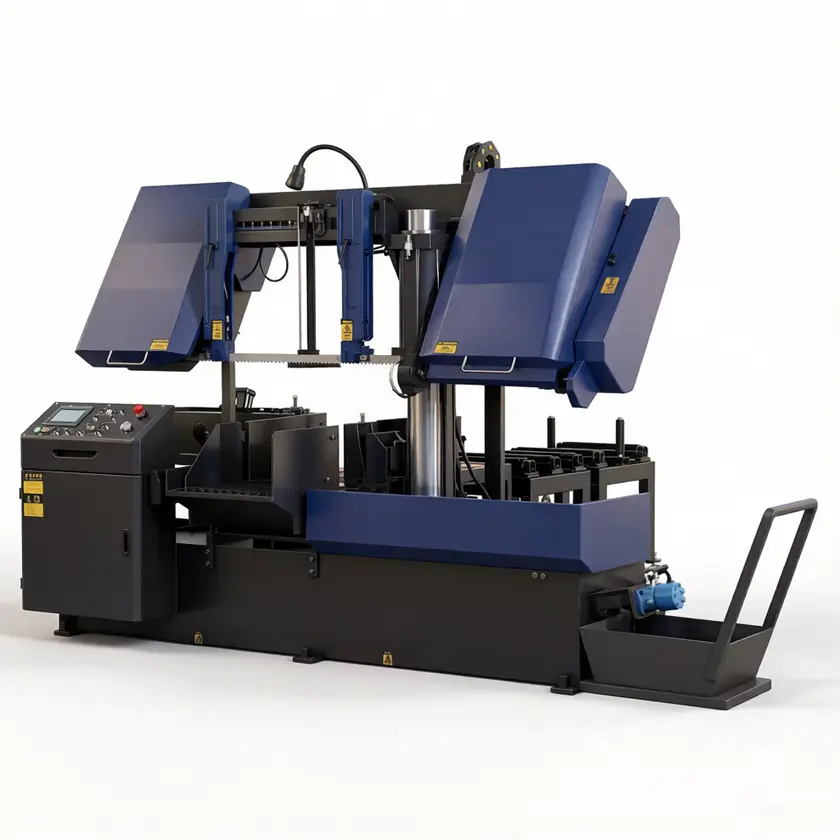
The blade is where a correctly sized machine becomes either productive or expensive. Two parameters do most of the work: width, which sets rigidity, and tooth pitch, which sets what thickness the blade can cut without snagging.
Width and thickness: rigidity and straightness
A wider, thicker blade resists deflection in a deep cut. That is why blade width tracks machine capacity across the range — 27 mm on the swing-arm saws, 34 mm on the 350 mm dual-column, 41 mm on the 400 mm vertical, up to 54 mm on the largest sections.
| Blade width | Typical use | Notes |
|---|---|---|
| 13 mm | Contour cutting on vertical saws | Small radius capability, low rigidity |
| 20 mm | Light general cut-off | Small benchtop and light-duty saws |
| 27 mm | General cut-off, up to ~250 mm | The standard blade for swing-arm saws |
| 34 mm | Thick and hard material, 300–350 mm | Higher tension needed; better straightness |
| 41 mm | Large section and plate, 400 mm class | Vertical saws and heavy dual-column |
| 54 mm | Maximum section capacity | Requires matched machine rigidity and power |
Blade width against application. Fitting a wider blade than the machine was designed for overloads the tension system and shortens blade life.
Tooth pitch: the 3-to-24 rule
The working rule is that between 3 and 24 teeth should be in contact with the cut at any moment. Fewer than three and the gullets cannot hold the chip, the blade snags and teeth strip. More than 24 and the teeth rub rather than cut, generating heat and work-hardening the surface.
| Workpiece thickness / wall | Tooth pitch | Typical workpiece |
|---|---|---|
| Over 100 mm solid | 2–3 TPI | Large billet, heavy round bar |
| 50–100 mm solid | 3–4 TPI | Medium bar, thick plate cut-off |
| 20–50 mm solid | 4–6 TPI | General bar and heavy tube |
| 10–20 mm, or thin-wall tube | 6–10 TPI | Tube, small bar, thin section |
| Under 10 mm, sheet, thin wall | 10–14 / 14–18 TPI | Thin-wall tube, sheet stacks, small profiles |
Tooth pitch selection. Variable-pitch blades (for example 3–4 or 4–6) reduce vibration and are the better general-purpose choice.
The most common blade failure in real workshops is not a manufacturing defect — it is a 4–6 TPI blade being used on 2 mm wall tube because that was the blade in the machine. At 2 mm wall, only one or two teeth are in the cut, the gullet overloads, and teeth strip within a few dozen cuts. The fix costs nothing: keep a second blade in 10–14 TPI for thin-wall work.
Blade material
Bi-metal (HSS tooth edge on a flexible back) is the default for general metal cutting and covers carbon steel, stainless and most alloys. Carbide-tipped blades cost several times more but hold up on hard or abrasive material — high-strength steel, castings with scale, and difficult stainless grades — and produce a flatter cut face. For a shop cutting mostly mild steel, bi-metal is the economic choice; for tool steel and hard alloys, carbide pays for itself in blade changes avoided.
Coolant and speed go with the blade
Blade, speed and coolant are one decision, not three. Running the right blade at the wrong speed destroys it as effectively as the wrong blade. The practical ranges for a horizontal bandsaw are:
| Material | Blade speed | Feed and coolant note |
|---|---|---|
| Low-carbon / mild steel | 60–90 m/min | Flood coolant, moderate feed |
| Medium-carbon / alloy steel | 40–60 m/min | Flood coolant, slightly reduced feed |
| Stainless steel | 20–35 m/min | Higher feed pressure, never let the blade rub |
| Tool steel / die steel | 20–30 m/min | Low speed, steady feed, generous coolant |
| Cast iron | 30–45 m/min | Dry or mist possible; watch abrasive scale |
| Aluminium | 300–1,000 m/min | Coarse pitch, high speed, lubricant rather than flood |
Starting blade speeds by material. Always confirm against the blade manufacturer's recommendation for the specific grade.
Now look at the speed options on the machines. The swing-arm BSE range runs 40/80 m/min at 60 Hz — two speeds, with 40 as the low end. That covers mild and medium-carbon steel well, but 40 m/min is above the recommended range for stainless and tool steel. The dual-column BSH range runs 27/45/69 m/min, and 27 is inside the stainless window.
This is a specification decision, not a preference
If stainless or tool steel is a meaningful share of your work, a two-speed saw with a 40 m/min floor will cost you blades and cut-face quality for the life of the machine. Either specify a three-speed or variable-speed model, or accept that the saw is a carbon-steel machine and plan the stainless work elsewhere. Do not assume "it has a low speed" means the low speed is low enough.
7. Motor power and cutting rate
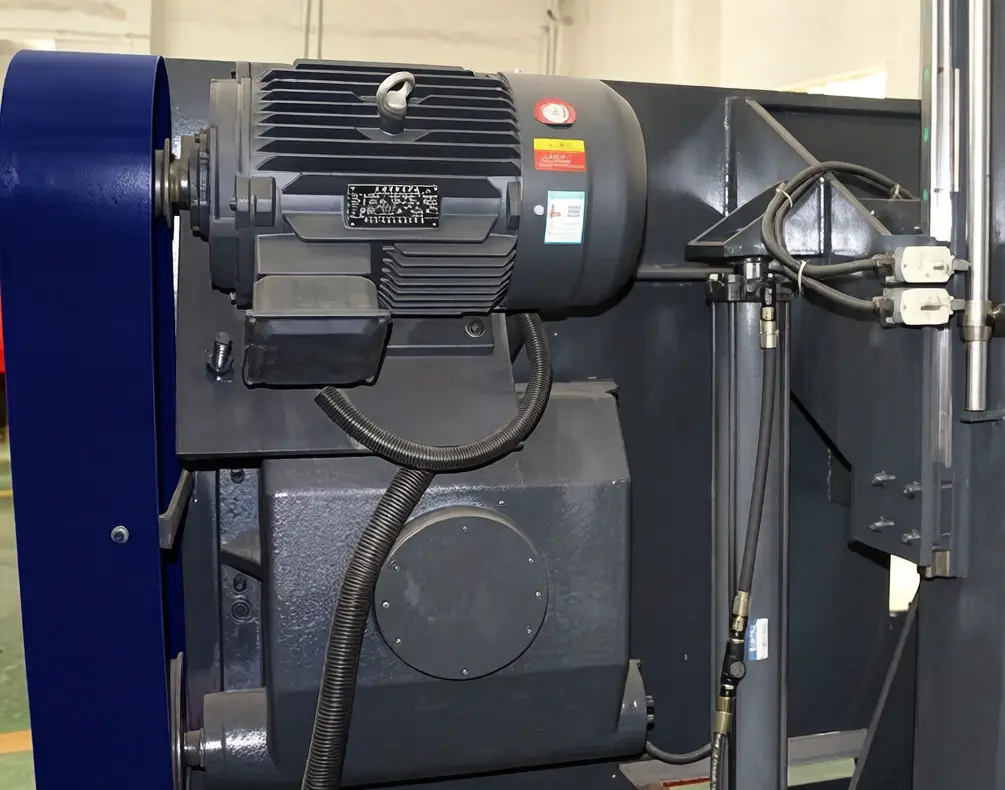
Motor power is a proxy for how fast the machine can push a blade through a given section without stalling. It is not a quality indicator on its own — a 3 kW motor on a flimsy frame produces vibration, not speed — but across a coherent range it tracks capacity closely.
| Model | Structure | Capacity | Main motor | kW per 100 mm |
|---|---|---|---|---|
| BSE-280 | Swing arm | Φ220 mm | 0.75/1.1 kW | 0.50 |
| BSE-315 | Swing arm | Φ230 mm | 0.75/1.1 kW | 0.48 |
| BSE-460 | Swing arm | Φ330 mm | 1.5/2.2 kW | 0.67 |
| BSH-28S | Dual column | 280 mm square | 2.2 kW | 0.79 |
| BSH-35S | Dual column | 350 mm square | 3 kW | 0.86 |
| BSV-40 | Vertical | 400 mm square | 3 kW | 0.75 |
Motor power against capacity. Dual-column saws carry more power per millimetre because the rigid frame can actually use it.
A useful sanity check when comparing quotes from different suppliers: divide the motor power by the square-section height in metres. A saw claiming 400 mm capacity on a 1.5 kW motor is either slow, or the capacity figure is optimistic, or both. Conversely, very high power on a light frame suggests the machine will chatter rather than cut faster.
Two supporting motors matter as much as the main one and are rarely discussed:
- Hydraulic motor — drives the vice clamping and the head feed. On a BSH-35S it is 0.75 kW against a 3 kW main motor; on the smaller BSH-28S it is 0.55 kW. Under-powered hydraulics show up as slow clamping and inconsistent feed pressure, which is a blade-life problem disguised as a cycle-time problem.
- Coolant pump — usually small, but a weak pump means poor chip evacuation, and poor chip evacuation means the blade re-cuts chips. That is one of the fastest ways to destroy a blade.
Drive type: worm gear versus gear drive
The swing-arm BSE range uses a gear drive; the dual-column BSH and vertical BSV ranges use worm gear transmission. Both are reduction systems that trade motor speed for blade torque. Worm drives are compact, quiet and give high reduction in one stage, which suits the low blade speeds and high torque of a dual-column saw. Gear drives are more efficient and simpler to service.
In practice the difference matters less than frame rigidity and blade tensioning. What does matter is whether the tension system is manual or hydraulic: on the BSH-35S, hydraulic blade tensioning is an option, and on high-volume work it is worth taking, because consistent tension is consistent straightness.
8. Remnant length and material yield
Nobody puts this in the quotation comparison, and it can cost more than the difference between two machines. Every saw leaves an unusable stub at the end of each bar, and the size of that stub is a machine specification.
On a circular saw with servo feed, the BSY-55X quotes a remnant of 70 mm plus the cut length. On a horizontal bandsaw the remnant depends on the vice position and the guide distance — commonly 100–150 mm, and worse if the vice has to be re-set for each cut.
loss = remnant + (cuts per bar × blade kerf)
// worked example: 6 m bar, 100 mm cut lengths, 1.1 mm kerf, 130 mm remnant
cuts per bar = (6000 − 130) ÷ (100 + 1.1) ≈ 58
material used = 58 × 100 = 5,800 mm of 6,000 mm → 3.3% loss
At 3% the remnant is a rounding error. At short cut lengths it is not. Cut 30 mm pieces from the same bar and the arithmetic changes: 188 cuts, 5,640 mm used, and the loss rises to about 6% — double the rate of the 100 mm job, on the same bar and the same machine. Add the fact that many saws cannot index below a minimum length, and the practical yield drops further. If your work is short repetitive pieces, ask for the minimum index length as well as the remnant, because that is the number that decides whether the automatic saw can actually run your job.
Yield check for short work
For cut lengths under 50 mm, model the job as: usable bar length ÷ (cut length + kerf), then check the result against the machine's minimum index length. If the minimum index is longer than your cut length, the automatic saw cannot run unattended on that job at all — and the labour saving you calculated disappears.
9. The selection sequence, in order
Following this order prevents the two expensive failure modes: buying too small because the angle capacity was ignored, and buying the wrong structure because the workpiece shape was never written down.
- Write down the workpiece envelope — height, width, length, weight, for the largest and the most common job.
- Decide the dominant angle — square cut, or routine mitring. This sets whether you size at 90° or at 45°.
- Choose the structure — swing-arm for mixed work and mitres, dual-column for thick straight cut-off, vertical for plate and large shapes.
- Check capacity against height first, then width, then round diameter. Add 10–15% margin, not 50%.
- Confirm the speed range covers your hardest material, not just your most common one.
- Specify blade width and a second pitch — the machine's standard blade plus the thin-wall blade you will actually need.
- Set the automation level from cuts per shift, and verify it by asking for the feed stroke and remnant figure.
- Calculate yield on your shortest cut length, and confirm the minimum index length.
- Then compare price — including the roller table, the second blade and the coolant, which are frequently quoted separately.
The one question that reveals a good supplier
Send your workpiece list and ask: "Which model, and where does it stop working?" A supplier who answers with a model and a specific limitation — "this covers everything except the 200 mm mitre, which needs the next size up" — has done the calculation. A supplier who answers with the largest model in the range has not.
10. Six specification mistakes that cost real money
1. Sizing on the 90° round capacity
The headline figure is the best case. On a swing-arm saw, capacity at 45° is roughly three quarters of the 90° figure, and at 60° less than half. If mitring is routine, this is the single most expensive mistake in bandsaw selection.
2. Ignoring the square-section height
A 220 mm round capacity saw accepts a 155 mm tall rectangle. Buyers comparing round figures across brands miss this entirely, and then find that the tall H-beam they cut every week does not fit. Compare height to height.
3. Assuming "low speed" means low enough
A two-speed saw with 40 m/min as its floor is a carbon-steel machine. Stainless wants 20–35 m/min. If stainless is in your mix, check the actual low-speed figure rather than the presence of a low-speed setting.
4. Reading "automatic" as automatic
Automatic head lowering is not automatic bar feed. Ask for the feed stroke and the remnant length. If the answer is about the head, the machine is semi-automatic.
5. One blade for every job
A 4–6 TPI blade on 2 mm wall tube strips teeth in dozens of cuts. The second blade costs a fraction of the downtime and the scrapped work. Budget for two pitches from the start.
6. Comparing machine price instead of cost per cut
A cheaper saw with a slower cycle, a shorter blade life and a larger remnant can cost more per finished piece than a machine that is 20% dearer. Add blade consumption, remnant loss and operator time to the comparison before deciding. On a high-volume job these three items routinely exceed the price difference.
Frequently asked questions
What size bandsaw do I need to cut 200 mm round bar?
You need a machine whose 90° round capacity is at least 220 mm, which leaves a small margin for blade wander and clamping. A swing-arm saw such as the BSE-280 (220 mm at 90°) is the minimum. But if you also cut at 45°, the same machine drops to 160 mm, so a 200 mm bar can no longer be mitred. Check the capacity at the angle you actually use, not the headline 90° figure.
Horizontal or vertical bandsaw — which one do I need?
Choose horizontal for cutting bar stock, tube, billet and structural sections to length, where the blade feeds down through a fixed workpiece. Choose vertical when the workpiece is a plate or a large awkward shape that must be moved against a stationary blade, or when you need contour cutting. Horizontal saws dominate production cut-off work; vertical saws dominate toolroom and plate work.
How many teeth per inch should a bandsaw blade have?
Keep between 3 and 24 teeth in contact with the cut at all times. For solid bar over 100 mm use 2–3 TPI, for 50–100 mm use 3–4 TPI, for 20–50 mm use 4–6 TPI, for thin-wall tube and small sections use 6–10 TPI, and for sheet or very thin wall use 10–14 or 14–18 TPI. Too few teeth means the gullets overload and the blade snags; too many means the teeth rub instead of cutting and work-harden the surface.
Can a bandsaw cut stainless steel?
Yes, but stainless needs lower blade speed and higher feed pressure than carbon steel, plus a coolant that suits the grade. Run stainless at roughly 20–35 m/min. A machine with only two speeds starting at 40 m/min is too fast for stainless and will shorten blade life; a three-speed machine with a 27 m/min low range is the better match. Use a bi-metal blade with a positive rake and do not let the blade rub, because stainless work-hardens quickly.
Is a semi-automatic or fully automatic bandsaw better value?
Count cuts per shift and how often you change material. Below roughly 100 cuts per shift, or with frequent material and length changes, a semi-automatic saw is more flexible and costs less. Above that, with long runs of the same section, an automatic saw with powered bar feed pays back through operator time and consistent length. Be careful with terminology: a saw that only lowers the head automatically is semi-automatic, not automatic. Automatic means powered indexing of the material.
How long does a bandsaw blade last?
Blade life is driven by tooth pitch, speed and coolant far more than by blade brand. A correctly matched bi-metal blade cutting mild steel at the right speed and feed typically lasts several thousand cuts. The usual causes of early failure are wrong TPI for the wall thickness, running too fast on stainless or tool steel, insufficient coolant flow, and a badly worn wire-brush or guide. Blade tension and guide alignment matter as much as the blade itself.

 Related News
 Related Products