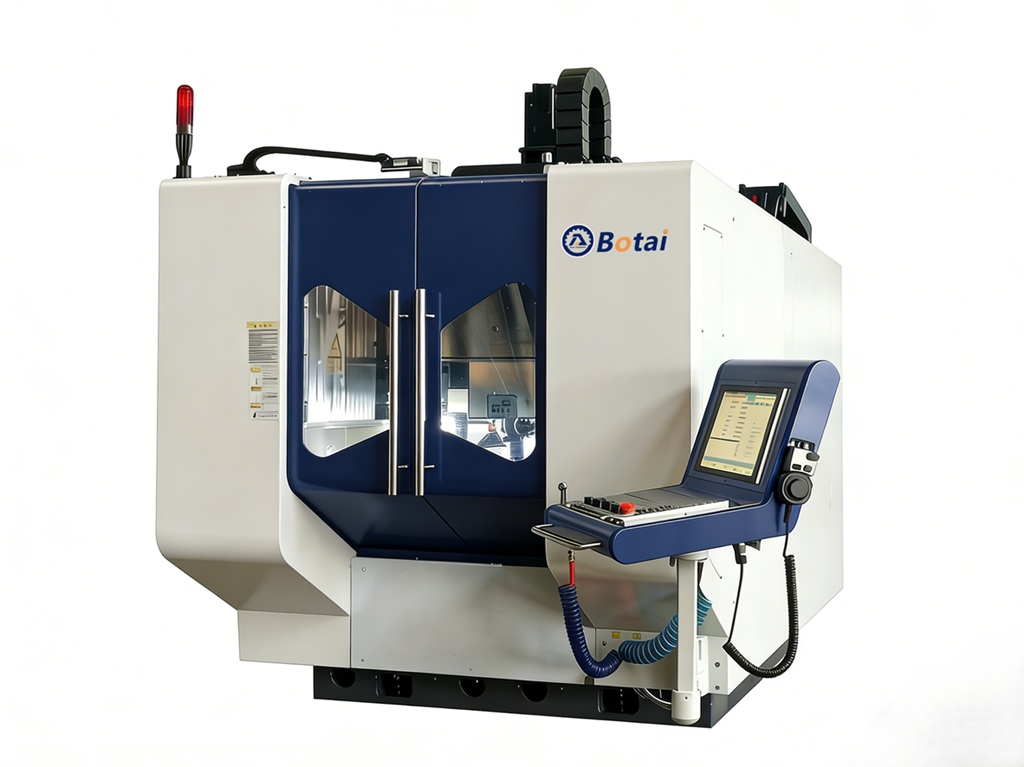
Hydraulic presses are core equipment in metal forming and assembly. From stamping and drawing automotive components and press-fitting motor housings to cold extrusion of hardware and forming powder metallurgy parts, the hydraulic press plays an irreplaceable role through powerful force output, smooth operation and flexible speed control.
Botai Industrial Equipment supplies a complete hydraulic press line covering four-column, C-frame, frame, gantry and special purpose structures — from 40 ton to 630 ton nominal force.
What this guide covers
- How Botai hydraulic press model numbers work
- The full range at a glance
- BHR — four-column
- BHA — C-frame single column
- BHF — frame with die cushion
- BHG — gantry
- BHS — special purpose
- How to choose the right structure
- Frequently asked questions
How Botai Hydraulic Press Model Numbers Work
Every Botai hydraulic press follows one naming system, so a model number tells you the structure type and the nominal force at a glance.
- B — Botai
- H — Hydraulic Press
- Third letter — the structure: R for Four-Column, A for C-Frame, F for Frame, G for Gantry, S for Special Purpose
- Number — nominal force in tons
| Reading a model number |
|---|
| BHR-100 = Botai Hydraulic press, R (four-column structure), 100 ton nominal force. |
| BHA-63 = Botai Hydraulic press, A (C-frame single column), 63 ton nominal force. |
The Full Range at a Glance
| Series | Structure | Force Range | Standard Models | Best For |
|---|---|---|---|---|
| BHR | Three-beam four-column | 63 – 630 ton | BHR-63, 100, 200 315 / 500 / 630 on request | General stamping, drawing, press-fitting, powder metallurgy |
| BHA | C-frame single column | 63 – 315 ton | BHA-63, 100, 200 315 on request | Bearing press-fitting, rotor assembly, shaft straightening |
| BHF | Integrated frame with die cushion | 200 – 630 ton | BHF-200, 315 400 / 500 / 630 on request | Automotive panel drawing, appliance panels, large hardware |
| BHG | Gantry frame | 40 – 200 ton | BHG-40, 100, 160, 200 | Long shaft straightening, large structure press-fitting |
| BHS | Special purpose | Custom — quoted on a project basis | Non-standard tooling, special table dimensions, multi-station | |
| About project-basis models |
|---|
| presses above the standard range (BHR-315/500/630, BHA-315, BHF-400/500/630) and all BHS special purpose machines are quoted per project. Send us your part drawings and process requirements and our engineers will confirm feasibility, configuration and lead time. |
BHR — Four-Column: The Workhorse for General Forming
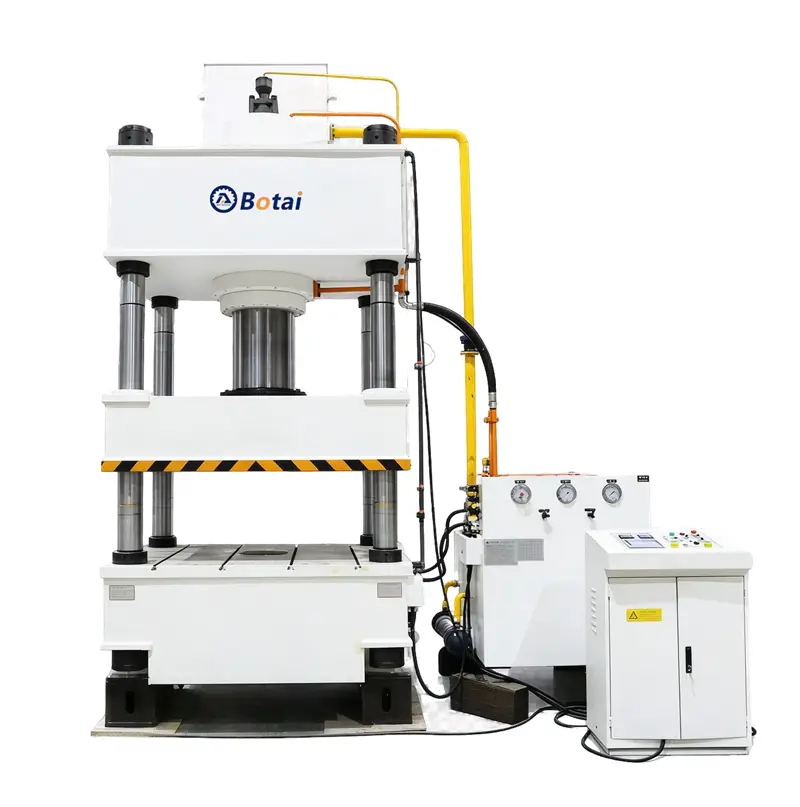
Four-column presses are the most widely used hydraulic press structure, because the four columns constrain the slide in both directions. That gives excellent guiding accuracy and strong resistance to eccentric loads — the off-centre forces that appear whenever a die is not perfectly balanced.
The BHR series uses a three-beam four-column structure, with standard models at BHR-63, BHR-100 and BHR-200. Larger tonnages up to BHR-630 are available on a project basis.
What you can upgrade
- Four-beam four-column structure — adds upper and lower beams for greater rigidity and more working space
- Servo or CNC control — precise pressure, speed and position programming
- Die cushion — where drawing requires controlled blank-holding force
Typical work: general stamping, drawing, press-fitting and powder metallurgy forming.
| BHR-63 |
|---|
| Four-Column Hydraulic Press |
| 63 ton nominal force · 520×520 mm worktable · three-beam four-column — entry point for small pressing work |
BHA — C-Frame Single Column: Fast Access for Press-Fitting
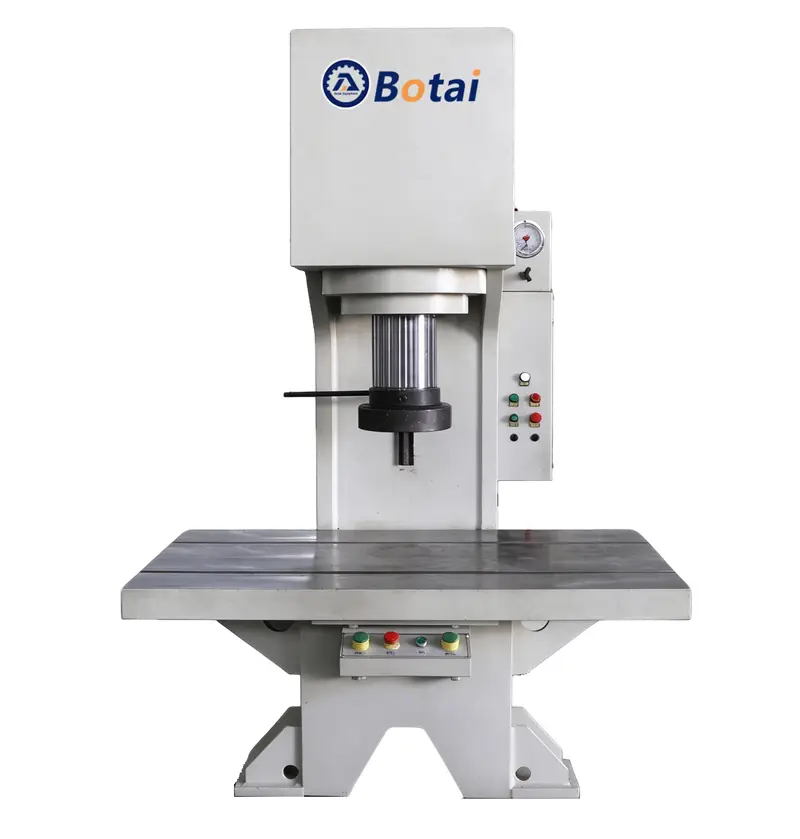
The C-frame press opens on three sides. That single design decision is why it dominates press-fitting and straightening work: you can load an awkward assembly, slide tooling in from the side, and see what you are doing — none of which is easy on a four-column frame.
The BHA series uses forged steel cylinders and hardened piston rods, which is where reliability and service life are decided in a hydraulic press. Standard models are BHA-63, BHA-100 and BHA-200, with BHA-315 available on request.
Servo or CNC control is available to raise automation and control precision. Typical work: bearing press-fitting, motor rotor assembly, shaft straightening and sheet bending.
| BHA-63 |
|---|
| Single Column Hydraulic Press |
| 63 ton nominal force · C-frame, three-side open · 25 MPa hydraulic pressure — universal press for fitting and forming |
| BHA-100 |
|---|
| Single Column Hydraulic Press |
| 100 ton nominal force · C-frame with wide throat · 28 MPa hydraulic pressure — universal for fitting and forming |
BHF — Frame with Die Cushion: Large Table, High Rigidity
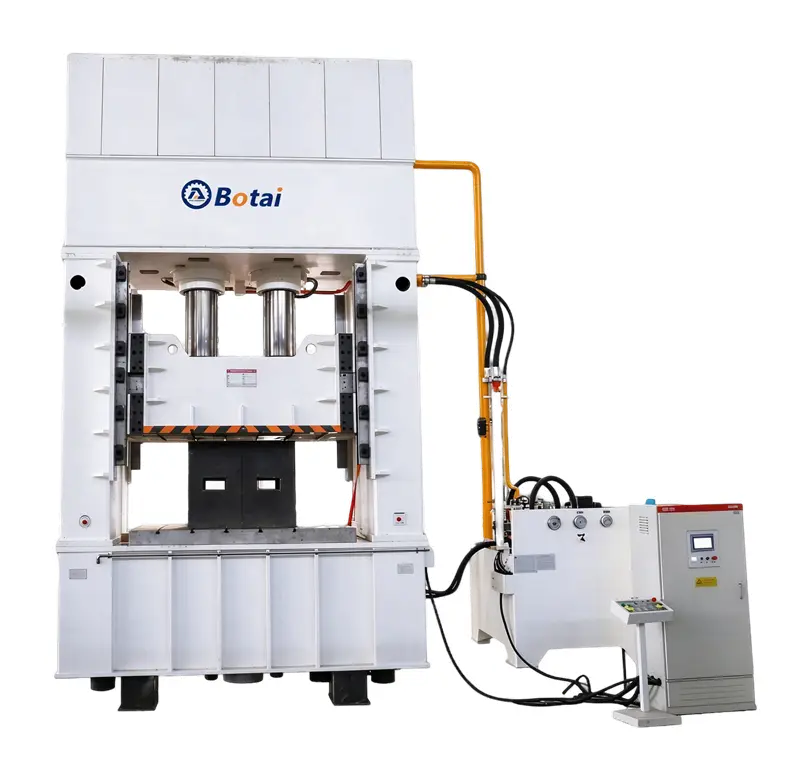
The BHF series uses an integrated frame body. The closed frame is far stiffer than a C-frame, and the design is specifically built around two requirements that appear together in panel work: a large table and high eccentric load resistance.
Standard models are BHF-200 and BHF-315, with larger tonnages up to BHF-630 on request. Die cushion capacity runs from 630 kN to 1600 kN depending on model — this is the blank-holding force that prevents wrinkling during drawing.
Where BHF wins
- Automotive panel drawing — table size and blank-holding force both matter
- Appliance panel stamping — large flat panels need even pressure distribution
- Large hardware forming — where a four-column frame runs out of table→
| BHF-200 |
|---|
| Frame Hydraulic Press |
| 200 ton nominal force · 630 kN die cushion · frame structure — built for drawing and forming |
BHG — Gantry: Open Working Space, Economical
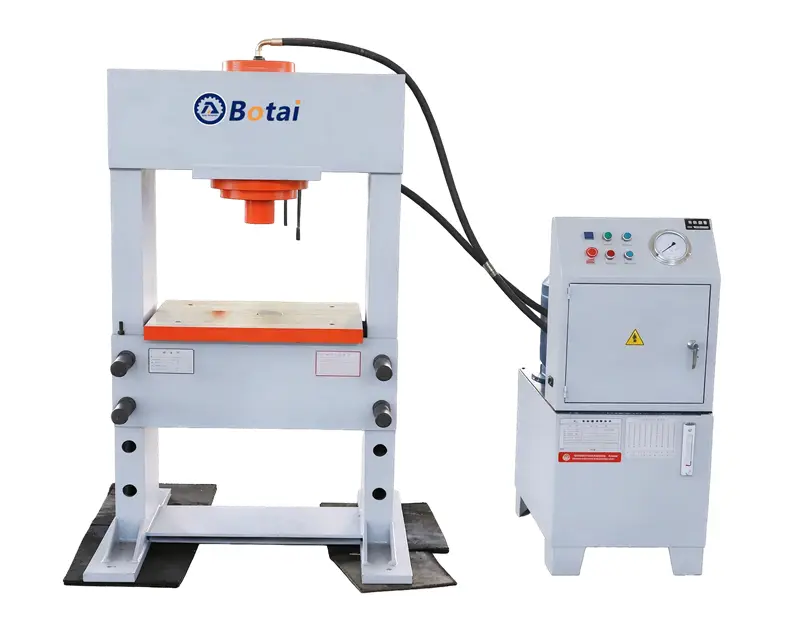
The gantry structure leaves the working envelope open, which is exactly what long parts need. Standard models run BHG-40, BHG-100, BHG-160 and BHG-200 — the full 40–200 ton range is available as standard.
Known for stable performance and high cost-effectiveness, the BHG series suits straightening long shaft parts, press-fitting large structural components, and any process that needs more operating space than a conventional frame allows. Servo or CNC control is optional.
| BHG-40 |
|---|
| Gantry Hydraulic Press |
| 40 ton nominal force · gantry structure · 23 MPa system pressure — for small to medium bending and pressing |
BHS — Special Purpose Presses
Some processes do not fit a standard model: dedicated tooling integration, non-standard table dimensions, high-temperature forming, or multi-station linkage. For these, Botai offers BHS special purpose press development.
Our technical team works with partner factories to develop a dedicated hydraulic solution based on your part drawings, process requirements and production cycle times. These are quoted on a project basis after a feasibility review.
How to Choose the Right Structure
Buyers usually arrive knowing their tonnage but unsure about structure. The decision is driven by three questions.
| If your priority is… | Choose | Because |
|---|---|---|
| Guiding accuracy and off-centre load resistance | BHR four-column | Four columns constrain the slide in both directions |
| Fast loading and clear access to the tooling area | BHA C-frame | Open on three sides — no frame in the way |
| Large panels and controlled blank-holding force | BHF frame | Integrated frame rigidity plus a die cushion |
| Long parts and a wide open working envelope | BHG gantry | Open gantry structure with no side obstruction |
| A process no standard model covers | BHS special | Built around your tooling and cycle requirements |
| Sizing rule |
|---|
| Define your heaviest routine job, calculate the force it needs, then add 20–30% headroom. Buying for the one-off part you press twice a year means paying for capability you rarely use — subcontract that job instead. |
Frequently Asked Questions
How do I choose between four-column, C-frame, frame and gantry hydraulic presses?
Four-column presses (BHR) give the best guiding accuracy and eccentric load resistance, so they suit most general stamping, drawing and press-fitting. C-frame presses (BHA) open on three sides, which makes loading awkward parts and tooling much faster — the right choice for bearing press-fitting, rotor assembly and straightening. Frame presses (BHF) combine a large table with high rigidity and are built for large-panel drawing where blank-holding force matters. Gantry presses (BHG) offer an open working envelope for long shafts and large structural components.
What tonnage hydraulic press do I need?
Tonnage is set by the process, not by the part size alone. Press-fitting needs roughly the interference fit area multiplied by the required contact pressure, with a safety factor. Stamping and drawing depend on material shear strength, part perimeter, thickness and draw depth. A practical starting point is to define your heaviest routine job, calculate the force it needs, then add 20–30% headroom. Send us your part drawing and process and our engineers will run the calculation.
What is a die cushion and do I need one?
A die cushion is a hydraulic or pneumatic cushion built into the press bed that applies controlled blank-holding force during drawing, preventing the sheet from wrinkling as the punch pulls material inward. If you draw cups, panels or any part with a significant draw depth, you need one — the BHF frame series includes die cushion capacities from 630 kN to 1600 kN depending on model. For pure stamping, press-fitting or straightening, a die cushion is usually unnecessary.
Do I need a servo or CNC hydraulic press?
A standard hydraulic press with manual or simple relay control is enough for single-operation pressing where the operator sets pressure and stroke. Choose servo or CNC control when you need repeatable pressure and position programs, multi-step profiles, stored recipes for different parts, or integration with automation. The upgrade pays back wherever setup time between jobs is significant or where process parameters must be recorded for traceability.
Can you supply a 500 ton hydraulic press?
Yes. The BHR four-column series runs from 63 to 630 ton and the BHF frame series from 200 to 630 ton. Standard models up to 200 ton for BHR and 315 ton for BHF are quoted directly; larger tonnages (BHR-315/500/630, BHA-315, BHF-400/500/630) are quoted on a project basis after our engineers confirm feasibility, configuration and lead time against your part requirements.
Why Buy Hydraulic Presses from Botai
Botai Industrial Equipment is an integrated manufacturing and trading machine tool provider. Our engineering team works on-site at our partner factories during production, controlling specification, tooling and quality from raw material to final run-off.
- Engineer-led selection. Press selection involves nominal force, table size, opening height, stroke, speed and control method. We recommend the structure type and specification against your actual process, not a catalogue page.
- On-site quality control. From frame welding quality and cylinder machining precision to hydraulic system sealing and electrical control stability, our technical director supervises production and provides verifiable proof before shipment.
- Factory-direct cost structure. The integrated model removes redundant intermediary layers, so verified equipment quality comes at a reasonable cost.
- Full lifecycle support. Installation guidance, parameter tuning, spare parts supply and process optimisation — backed by engineers you can talk to directly.
 Related News
 Related Products