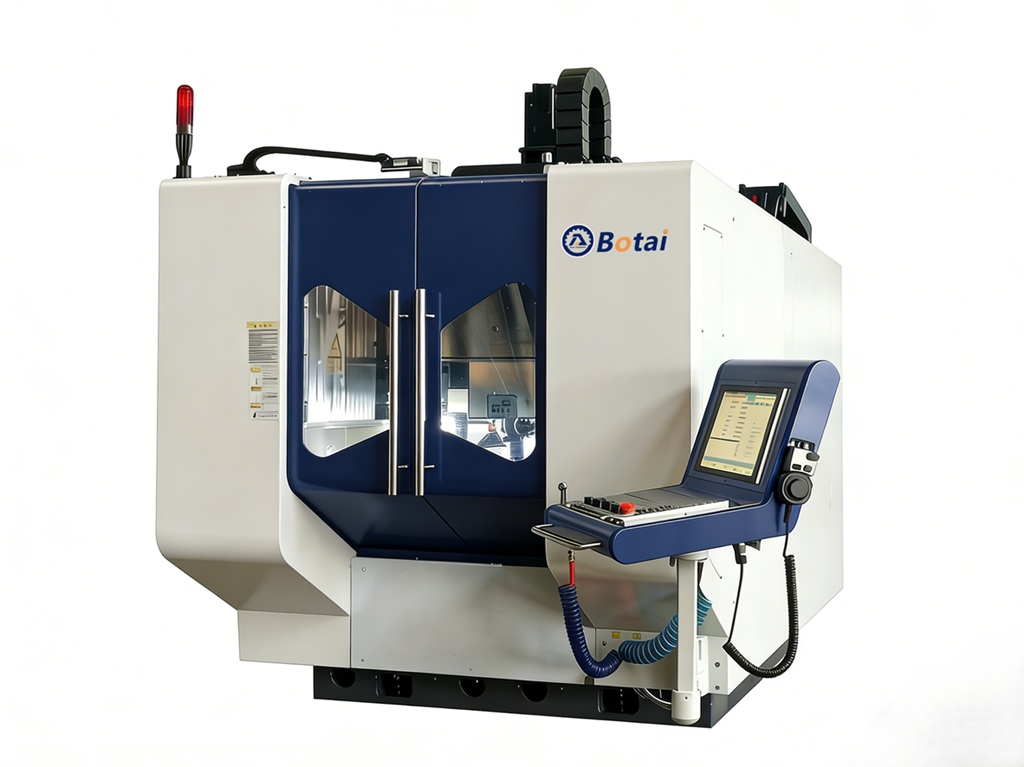
Laser processing is reshaping the efficiency boundaries of metal manufacturing. A fiber laser cutting machine completes contour cutting in minutes that would take a conventional punch press hours. A handheld laser welding gun multiplies welding speed while producing cleaner, more attractive welds. A laser marking machine leaves permanent, unremovable identification on part surfaces. For manufacturers pursuing efficiency, precision and flexibility, laser equipment has moved from optional to essential.
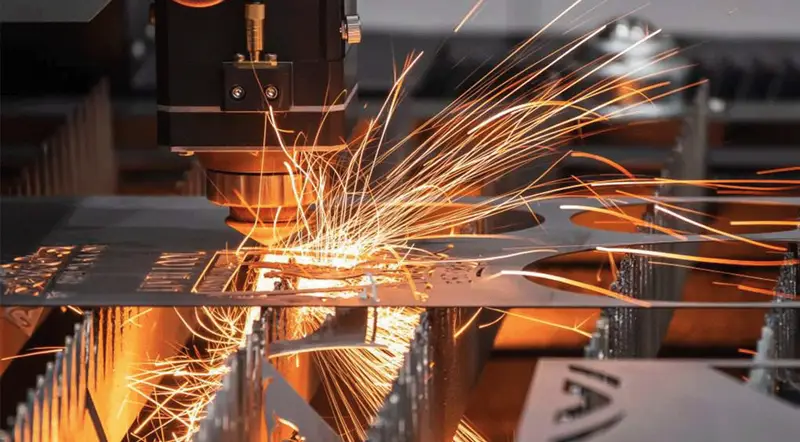
Botai Industrial Equipment supplies a complete laser processing line covering cutting, welding and marking — from 1 kW to 8 kW fiber laser cutting, tube cutting up to Φ280 mm, handheld welding up to 3 kW, and both fiber and CO₂ marking.
What this guide covers
- How Botai laser model numbers work
- The full range at a glance
- BLC-F — fiber laser sheet cutting
- BLC-T — tube laser cutting
- BLC-FT — combination sheet-tube
- BLW — handheld laser welding
- BLM — laser marking
- How to choose laser power
- Frequently asked questions
How Botai Laser Model Numbers Work
Every Botai laser machine follows one naming system, so a model number tells you the machine type, the processing format and the power at a glance.
- B — Botai
- L — Laser
- Third letter — the application: C for Cutting, W for Welding, M for Marking
- Cutting suffix — F for sheet cutting, T for tube cutting, FT for combination sheet-tube
- Numbers — processing format, tube specification, or power
| Reading a model number |
|---|
| BLC-3015F/3000 = Botai Laser Cutting, 3000×1500 mm sheet format, 3000 W laser power. |
| BLC-6024T/4000 = Botai Laser Cutting, tube machine with a 240 mm chuck, 4000 W laser power. |
The Full Range at a Glance
| Series | Application | Model Range | Power | Best For |
|---|---|---|---|---|
| BLC-F | Fiber laser sheet cutting | BLC-3015F/1000 → /8000 | 1 – 8 kW | Sheet metal fabrication, enclosures, general plate cutting |
| BLC-T | Tube & profile laser cutting | BLC-6024T/3000 → BLC-6028T/6000 | 3 – 6 kW | Fitness equipment, furniture, steel structures, automotive parts |
| BLC-FT | Combination sheet & tube | BLC-3015FT/1500 → /6000 | 1.5 – 6 kW | Multi-variety, small-batch work mixing plate and tube |
| BLW | Handheld fiber laser welding | BLW-1000H / 2000H / 3000H | 1 – 3 kW | Stainless doors & windows, kitchenware, sheet metal enclosures |
| BLM | Laser marking | BLM-20L / 30L / 50L (fiber); CO₂ series | 20 – 100 W | Part identification, serial numbers, QR codes, brand logos |
BLC-F — Fiber Laser Sheet Cutting
The BLC-F series is the workhorse of sheet metal fabrication. Models run from BLC-3015F/1000 to BLC-3015F/8000, with laser power from 1000 W to 8000 W on a standard 3000×1500 mm processing format.
Core specifications
- Positioning accuracy ±0.03 mm
- Repeat positioning accuracy ±0.02 mm
- Working area 3000×1500 mm standard
- Full-format customization — 4020, 6025, 8025 and beyond available on request
- Optional automation — dual exchange tables, automatic loading/unloading, dust extraction
This accuracy level covers the great majority of precision sheet metal work. If your parts are enclosures, brackets, panels or general plate components, a 3000 W fiber laser cutting machine handles most routine work, while a 6000 W machine extends into thicker plate without slowing the thin-gauge jobs.
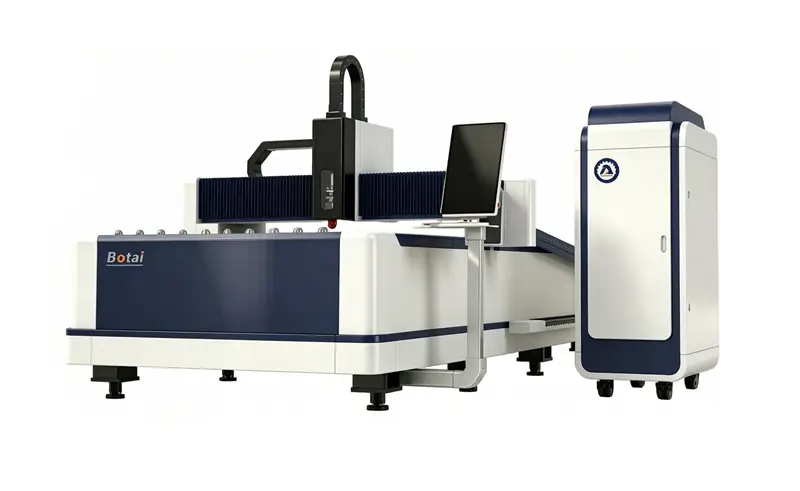
| BLC-3015F/3000 |
|---|
| Sheet Metal Fiber Laser Cutting Machine |
| 3000 W · 3000×1500 mm working area · cuts 0.5–16 mm steel — all-round fiber laser for general processing across multiple industries |
BLC-T — Tube & Profile Laser Cutting
Tube laser cutting is where a fiber laser delivers its clearest advantage over conventional sawing and drilling: holes, slots, mitres and complex contours cut in a single pass, on a profile that would otherwise need several operations.
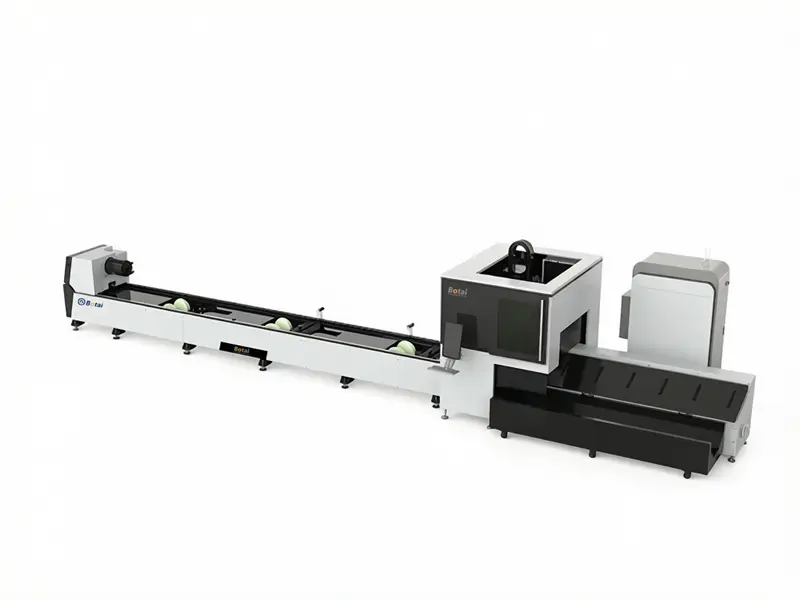
The BLC-T series runs from BLC-6024T/3000 to BLC-6028T/6000, with laser power from 3000 W to 6000 W.
| Workpiece Type | Clamping / Adaptation Range |
|---|---|
| Round tube | Φ20 – 280 mm |
| Square tube | □20 – 280 mm |
| I-beam | 10# – 20# |
| BLC-6024T/4000 |
|---|
| Professional Tube Fiber Laser Cutting Machine |
| 4000 W · 240 mm pneumatic chuck · 20–240 mm pipe range · 300 kg load — built for efficient small-pipe processing |
BLC-FT — Combination Sheet & Tube
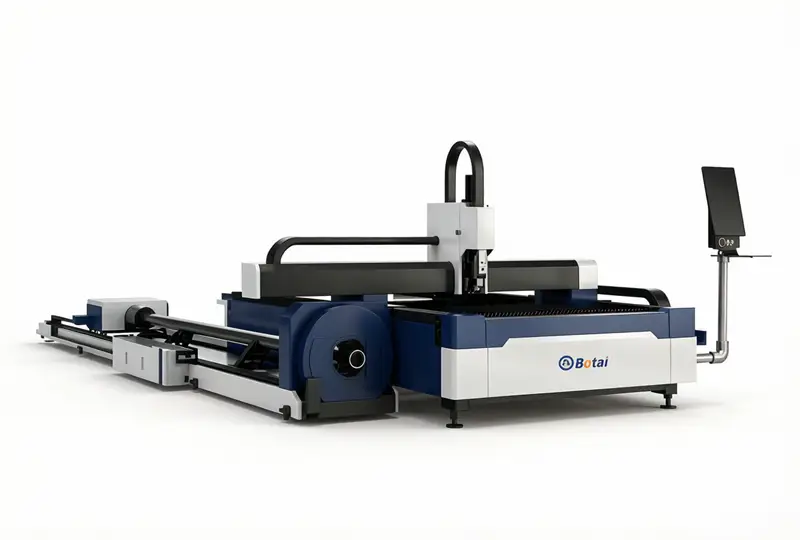
A combination machine mounts a chuck on the same bed as the sheet table, so one machine handles both flat plate and tube. Models run from BLC-3015FT/1500 to BLC-3015FT/6000, with a 3050×1530 mm processing format, Φ20–240 mm chuck clamping diameter and ±0.02 mm repeat positioning accuracy.
It makes most sense for multi-variety, small-batch production where you alternate between sheet and tube — saving both equipment investment and floor space. If either sheet or tube dominates your workload, a dedicated machine will usually deliver higher throughput.
BLW — Handheld Fiber Laser Welding
The Botai BLW series covers handheld fiber laser welding machines — BLW-1000H, BLW-2000H and BLW-3000H — with laser power from 1000 W to 3000 W.
Core specifications
- Wavelength 1070 nm — efficient absorption in metals
- Fiber length standard 10 m, maximum 15 m
- Welding speed 0–120 mm/s, several times faster than conventional TIG
- Cooling industrial water chiller for continuous operation
- Optional wire feeding
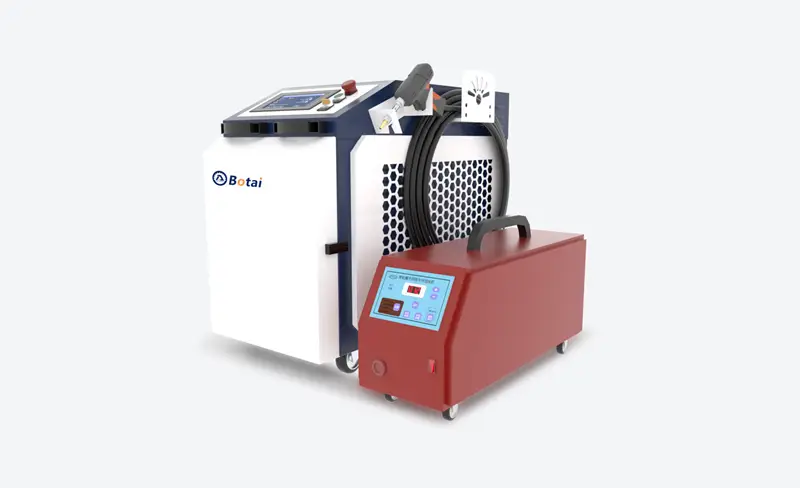
Compared with conventional welding, laser welding creates a smaller heat-affected zone, less deformation and a flatter bead — which sharply reduces subsequent grinding work. Typical applications include stainless steel doors and windows, kitchenware, advertising letters, sheet metal enclosures and automotive repair.
| BLW-3000H |
|---|
| Handheld Fiber Laser Welding Machine |
| 3000 W · 1070 nm wavelength · 0–120 mm/s — high-power handheld welder for 0.5–3 mm sheets |
BLM — Laser Marking
Botai supplies both fiber and CO₂ laser marking machines, because the material decides which type you need.
Fiber Laser Marking Machines
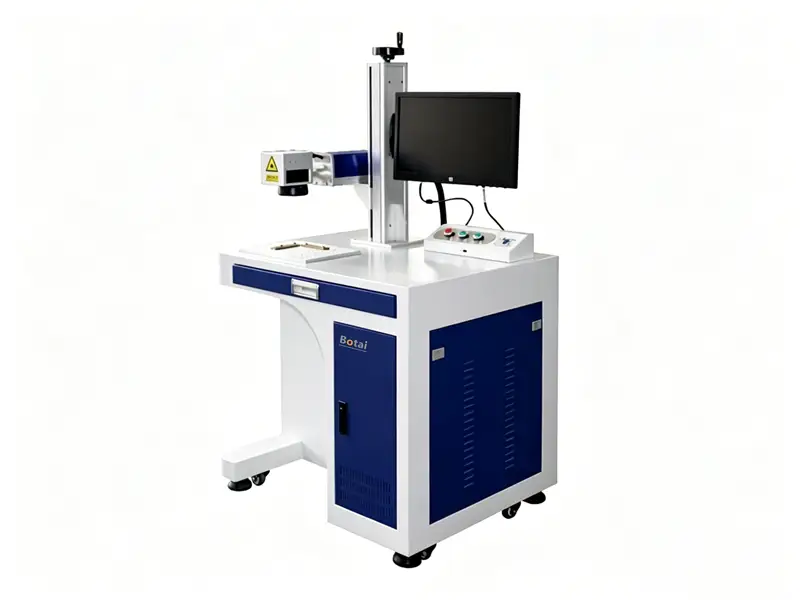
Models BLM-20L, BLM-30L and BLM-50L, with 20–50 W power and a Ytterbium fiber source. Standard working area is 100×100 mm or 150×150 mm. Suited to fine marking on metals — stainless steel, aluminium alloy, copper — and some coated materials. Common uses are serial numbers, QR codes and logos on hardware tools, medical devices, electronic components and automotive parts.
CO₂ Laser Marking Machines
A CO₂ source at 10.64 μm wavelength, 30–100 W power, with a standard 200×200 mm marking area (300×300 mm optional). Suited to non-metals: wood, acrylic, leather, glass, ceramics, plastics and paper packaging. Common uses are food packaging, crafts, garment accessories and advertising signage.
How to Choose Laser Power
Power is the specification buyers most often get wrong — usually by buying for the thickest part they might ever cut, rather than the thickest part they routinely cut.
| Working guide — mild steel |
|---|
| 1000–1500 W up to about 6 mm · 3000 W roughly 10–16 mm · 6000 W around 20–25 mm · 8000 W beyond that. |
Three points that follow:
- Stainless steel and aluminium cut thinner at the same power. They reflect more of the beam and conduct heat away faster, so allow one power step above the equivalent mild-steel job.
- Higher power also means faster thin-gauge cutting. If your work is mostly 2–3 mm sheet in volume, a higher-power machine can still pay back through cycle time rather than thickness capability.
- Size on routine work, not the exception. Buying a machine for the 1% of parts that need 20 mm means paying for capability you rarely use. Subcontract the occasional thick plate instead.
Frequently Asked Questions
What laser power do I need for cutting steel?
As a practical guide for fiber laser cutting of mild steel: 1000–1500 W handles up to about 6 mm, 3000 W covers roughly 10–16 mm, 6000 W reaches around 20–25 mm, and 8000 W goes beyond that. Stainless steel and aluminium cut thinner at the same power because they reflect more of the beam and conduct heat away faster. If you cut a mix of thicknesses, size on the thickest routine job and allow one step of headroom.
What is the difference between sheet laser cutting and tube laser cutting?
Sheet laser cutting machines (Botai BLC-F series) hold a flat plate on a 3000×1500 mm bed and cut two-dimensional contours. Tube laser cutting machines (BLC-T series) use a rotating chuck to hold round tube, square tube or profiles — Botai covers Φ20–280 mm round tube and □20–280 mm square tube, plus I-beam from 10# to 20# — and cut three-dimensional features such as holes, slots and mitres around the profile.
Can one machine cut both sheet and tube?
Yes — a combination sheet-tube machine (Botai BLC-FT series) mounts a chuck on the same bed as the sheet table. It suits multi-variety, small-batch production where you alternate between flat plate and tube, and it saves both equipment investment and floor space. If either sheet or tube dominates your workload, a dedicated machine will usually deliver higher throughput.
What is the difference between fiber and CO₂ laser marking?
Fiber laser marking machines (BLM-20L, BLM-30L, BLM-50L) use a 1070 nm beam and mark metals — stainless steel, aluminium alloy, copper and coated materials — with fine, permanent results for serial numbers, QR codes and logos. CO₂ laser marking machines use a 10.64 μm beam and mark non-metals such as wood, acrylic, leather, glass, ceramics, plastics and paper packaging. The material decides which type you need.
How fast is handheld laser welding compared with TIG?
Botai handheld fiber laser welders run at 0–120 mm/s, which is several times faster than conventional TIG welding. The heat-affected zone is smaller, so parts distort less and the weld bead is flatter — which sharply reduces subsequent grinding. A standard 10 m fiber cable (15 m maximum) keeps the gun mobile around large workpieces.
Do you supply tube laser cutting machines?
Yes. The Botai BLC-T series covers models from BLC-6024T/3000 to BLC-6028T/6000, with laser power from 3000 W to 6000 W. Round tube clamping range is Φ20–280 mm, square tube □20–280 mm, and I-beam from 10# to 20#. Send us your tube specification and wall thickness and our engineers will confirm the right model.
Why Buy Laser Equipment from Botai
Botai Industrial Equipment is an integrated manufacturing and trading machine tool provider. Our engineering team works on-site at our partner factories during production, controlling specification, tooling and quality from raw material to final run-off.
- Engineer-led selection. Laser parameters vary enormously. We size the machine on your material type, thickness, processing format, precision requirement and production volume — not on a catalogue page.
- On-site quality control. From laser source brand and cutting head precision to control system stability and bed rigidity, our technical director supervises production and provides verifiable proof before shipment.
- Factory-direct cost structure. The integrated model removes redundant intermediary layers, so verified equipment quality comes at a reasonable cost.
- Full lifecycle support. Installation guidance, parameter tuning, spare parts supply and process optimisation — backed by engineers you can talk to directly.
 Related News
 Related Products