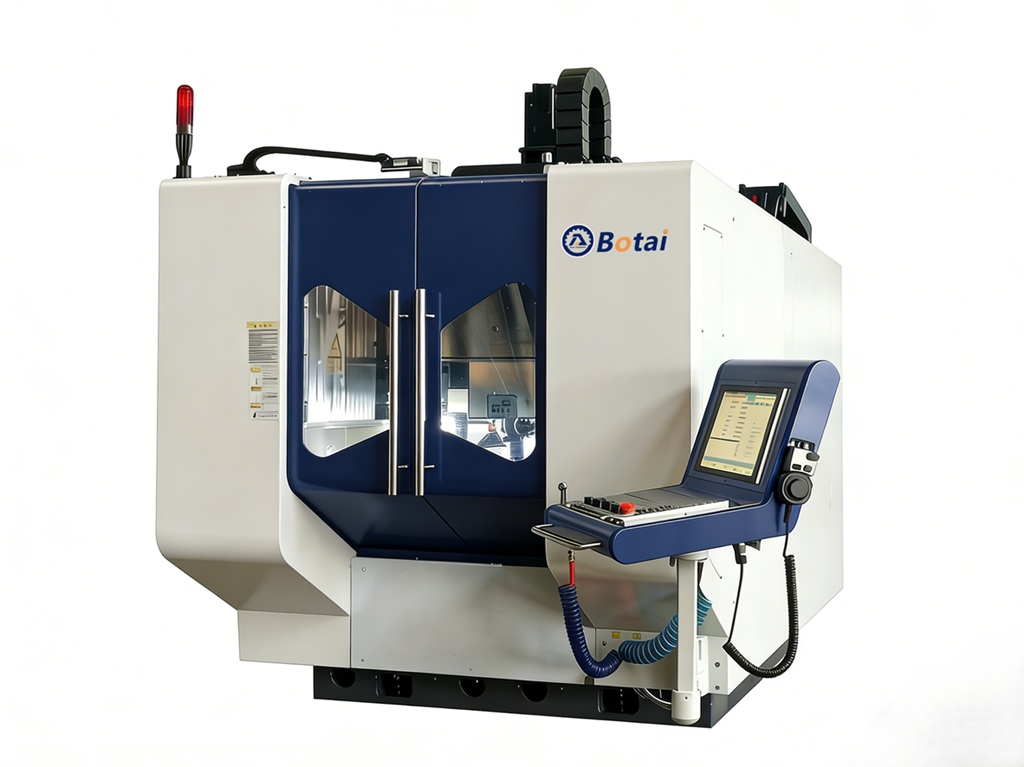
Bending is the core operation in sheet metal fabrication. A flat plate, formed through one or more bending cycles, becomes the side panel of an electrical cabinet, the reinforcement rib of an automotive panel, the stainless steel enclosure of food machinery, or the door of a control cabinet. Bending accuracy determines the quality of every subsequent welding and assembly step — and bending efficiency sets the cycle time of the entire production line.
Botai Industrial Equipment builds a complete press brake line covering torsion bar, electro-hydraulic servo and full electric servo configurations, from 40 ton to 320 ton and from 2000 mm to 6000 mm bending length. This guide explains how the range is organised, what each series is for, and how to match a machine to your parts.
What this guide covers
- How Botai press brake model numbers work
- The full range at a glance
- BPT torsion bar — the economical workhorse
- BPE electro-hydraulic servo — the precision core
- BPF full electric servo
- How to size press brake tonnage
- Frequently asked questions
How Botai Press Brake Model Numbers Work
Every Botai press brake follows one naming system, so a model number tells you the machine type, its nominal force and its bending length at a glance.
- B — Botai
- P — Press Brake
- Third letter — the drive type: T for Torsion Bar, E for Electro-hydraulic, F for Full Electric
- Suffix letter (electro-hydraulic only) — S for Standard, E for Economical, H for High-end High-speed
- Numbers — nominal force in tons / bending length in mm
Reading a model number
BPE-100/3200S = Botai Press Brake, Electro-hydraulic, 100 ton nominal force, 3200 mm bending length, Standard series.
The Full Range at a Glance
Five series cover everything from economical general bending to high-speed precision production:
| Series | Drive Type | Force Range | Bending Length | Best For |
|---|---|---|---|---|
| BPT | Torsion bar | 40 – 200 ton | 2500 – 6000 mm | General sheet metal, electrical cabinets, steel structures |
| BPE-S | Electro-hydraulic servo | 50 – 320 ton | 2000 – 6000 mm | Precision sheet metal, automotive parts, general fabrication |
| BPE-E | Electro-hydraulic servo | 63 – 250 ton | 2500 – 3200 mm | Cost-optimised precision bending |
| BPE-H | Electro-hydraulic dual servo | 63 – 250 ton | 2500 – 3200 mm | High-speed batch production |
| BPF | Full electric servo | Quoted per project | Clean workshops, electronic precision parts | |
BPT Torsion Bar — The Economical Universal Workhorse
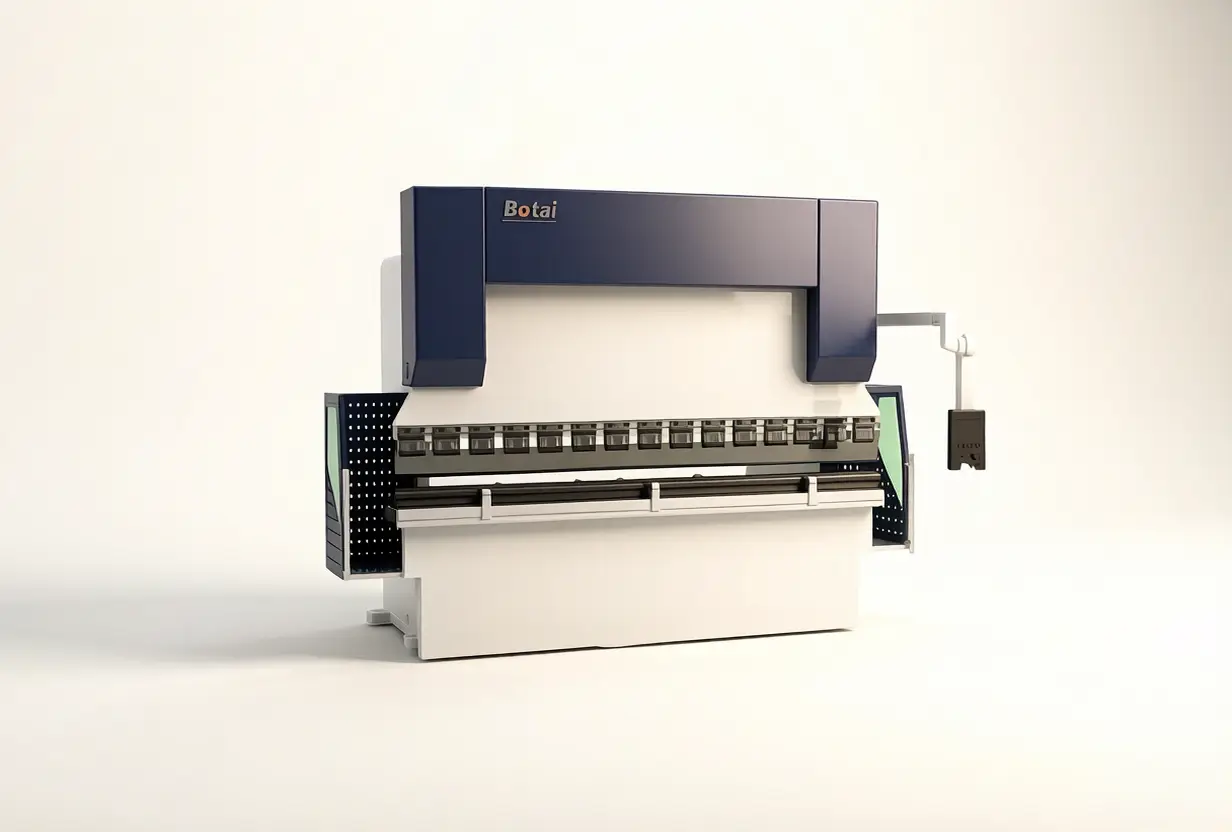
Torsion bar CNC press brakes are the most common machines in sheet metal workshops. The Botai BPT series uses a fully welded, rigid bed structure for excellent deformation resistance under long-term high-intensity use. The mechanical torsion shaft keeps both cylinders synchronised without the complexity of a closed-loop hydraulic system.
Core features
- Fully welded bed — stable structure that holds accuracy over years of production
- Multi-brand CNC system options — matched to your programming habits and local service support
- Ball screw backgauge — 0.1 mm positioning accuracy with reliable repeatability
- Quick tool change — fast die changeover to cut downtime between jobs
The BPT series covers 12 models from BPT-40/2500 to BPT-200/6000, spanning 40 ton to 200 ton and 2500 mm to 6000 mm. That range handles everything from thin-gauge sheet to medium-thick plate, and covers common requirements such as a 100 ton press brake for electrical cabinets or a 200 ton press brake for long structural work.
See more about BPT series →
BPE Electro-Hydraulic Servo — The Precision Core
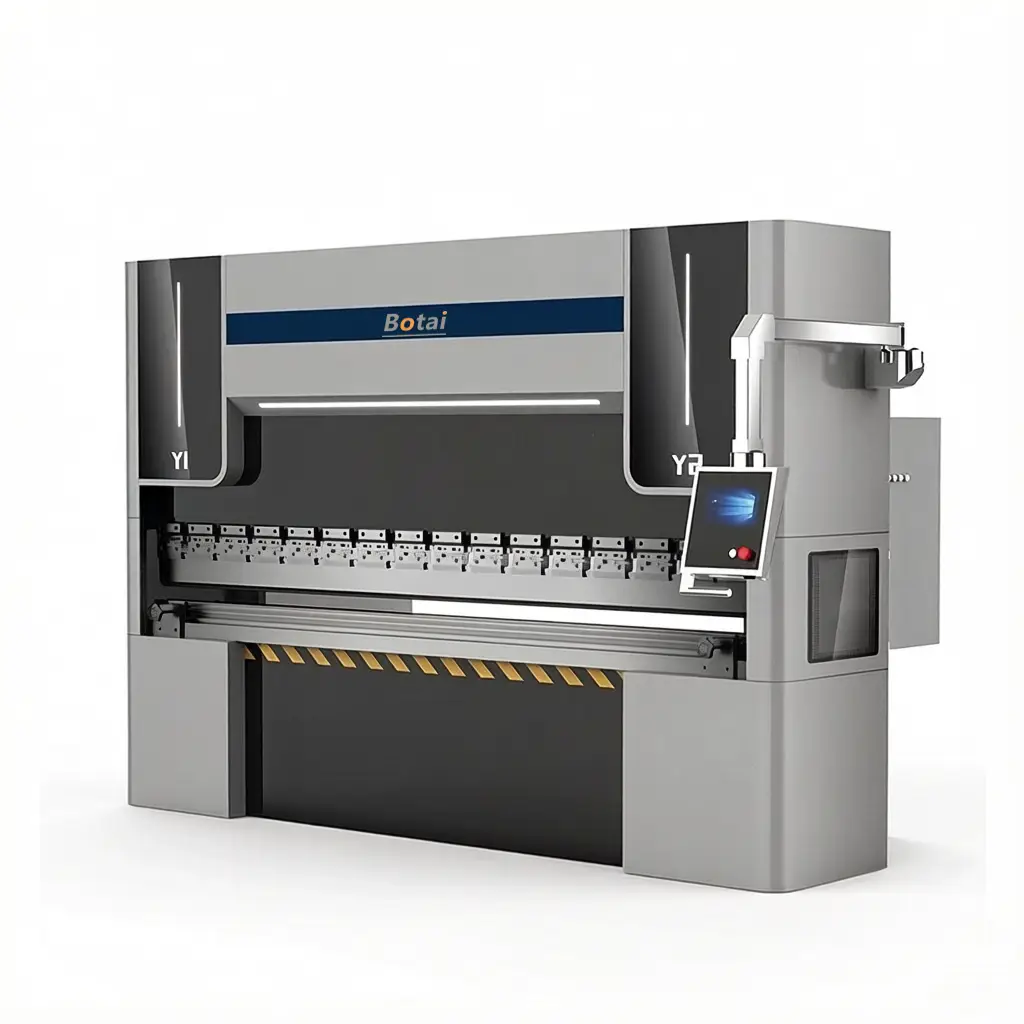
The electro-hydraulic servo press brake is the widest category in the Botai line. It is divided into three sub-series so you can match precision, cycle time and budget independently.
BPE-S — Standard Electro-Hydraulic Servo
The workhorse for general precision sheet metal bending. A valve-controlled single pump system drives two cylinders, each fitted with a proportional servo valve and a linear scale providing real-time position feedback. A CNC motorised deflection compensation system keeps the bend angle consistent across the full length of the machine — the effect that most often separates a good bend from a rejected part.
- Valve-controlled single pump system
- Welded rigid bed
- Proportional servo valve with linear scale feedback
- CNC motorised deflection compensation
- Minimal bending angle error, high repeatability
Coverage runs to 17 models from BPE-50/2000S to BPE-320/6000S — 50 ton to 320 ton, 2000 mm to 6000 mm. That includes the sizes most commonly requested for cabinet and panel work, such as a 100 ton 3200 mm press brake, as well as 4000 mm and 6000 mm machines for long structural components.
BPE-E — Economical Electro-Hydraulic Servo
The same architecture as BPE-S — welded rigid bed, proportional servo valve, linear scale feedback — with a valve-controlled plus servo pump system that reduces the cost structure. If your parts need servo-level accuracy but your volumes do not justify the high-speed series, BPE-E is usually the most cost-effective answer.
Covers 6 models from BPE-63/2500E to BPE-250/3200E, from 63 ton to 250 ton.
BPE-H — High-End High-Speed Electro-Hydraulic Servo
A dual servo hydraulic system with dual servo drive and linear scale control. The benefit is energy saving, higher approach and return speeds, and tighter cycle-to-cycle consistency — the characteristics that matter when bending is a bottleneck in a high-volume line. Available in 6 models from BPE-63/2500H to BPE-250/3200H.
See more about BPE Electro-Hydraulic Servo→
Which electro-hydraulic series?
BPE-S if you want the proven standard for mixed precision work. BPE-E if precision matters but budget is the constraint. BPE-H only when cycle time is a genuine production bottleneck.
BPF Full Electric Servo
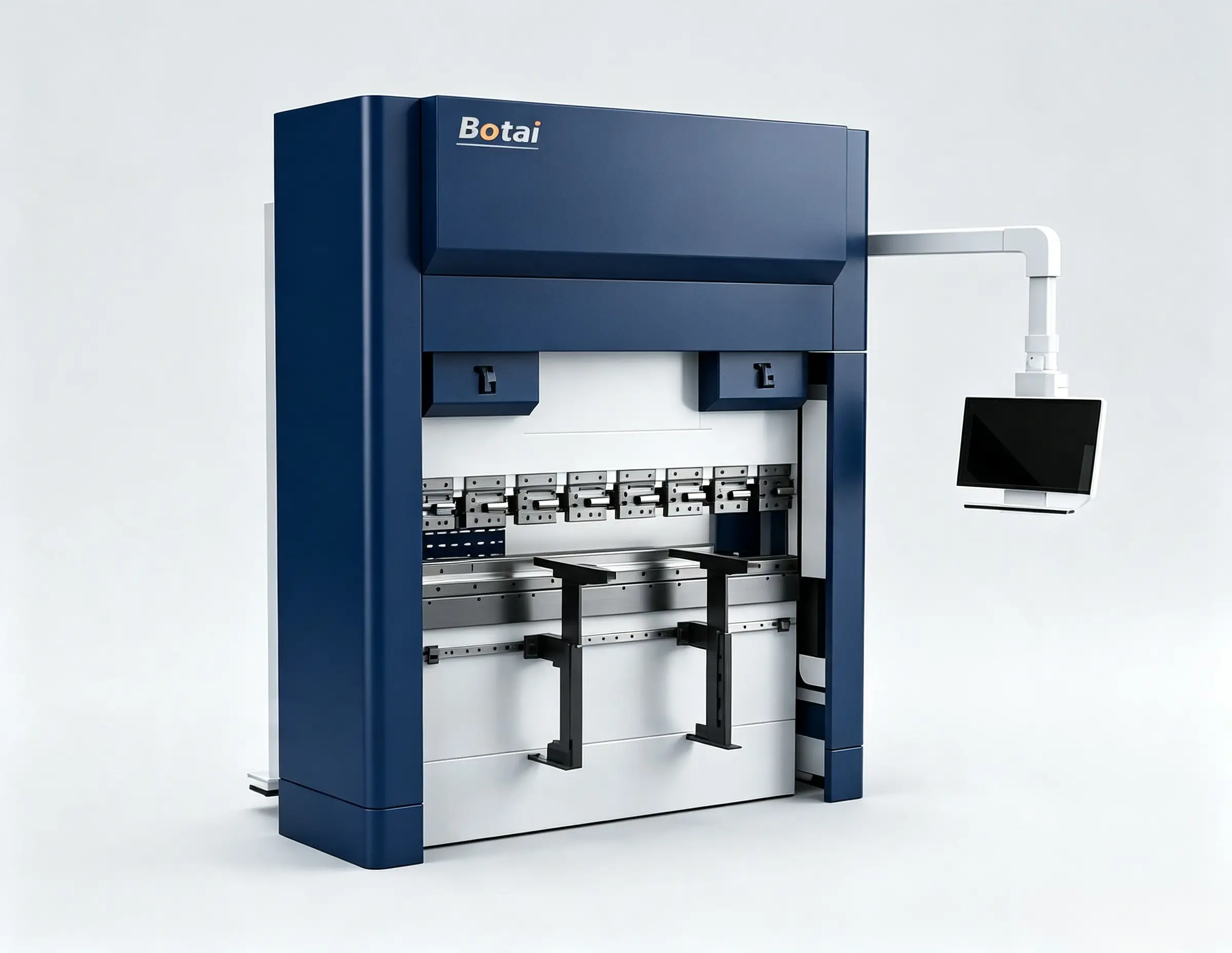
Full electric servo press brakes replace the hydraulic system entirely with all-electric drive and servo screw transmission. That removes hydraulic oil, pumps and valve groups from the machine — which means near-zero standby power consumption, consistent positioning from direct servo control, and dramatically reduced daily maintenance. They suit clean workshops and precision parts where oil contamination or maintenance downtime is unacceptable.
The BPF series is quoted on a project basis. If full electric is the right answer for your application, send us your part specifications and our engineers will confirm feasibility, configuration and lead time.
How to Size Press Brake Tonnage
Tonnage is the specification buyers most often get wrong — usually by sizing on the average part rather than the heaviest one.
Working rule
For a simple 90° air bend in mild steel, allow roughly 1 ton per mm of thickness per metre of bending length. Bending 4 mm steel across 3 metres therefore calls for about 120 ton. Stainless steel and other high-tensile materials need roughly 1.5–2× that figure.
Three practical points that follow from this:
- Size on your worst case, not your average. The heaviest material at the longest length sets the requirement.
- Longer bed means less available tonnage per metre. A 100 ton machine with a 4000 mm bed delivers far less force per metre than the same 100 ton on a 2500 mm bed.
- Leave margin. Bending radius, die opening and material batch variation all move the real requirement upward.
Frequently Asked Questions
How do I choose the right press brake tonnage for my parts?
Tonnage depends on material, thickness and bending length. As a working rule, mild steel needs roughly 1 ton per mm of thickness per metre of bending length for a simple 90° air bend — so bending 4 mm steel over 3 metres calls for about 120 ton. Higher-tensile materials such as stainless steel need roughly 1.5–2× that figure. Always size on your heaviest and longest part, not the average one.
What is the difference between torsion bar and electro-hydraulic press brakes?
A torsion bar press brake (Botai BPT series) uses a mechanical torsion shaft to keep both cylinders synchronised. It is simpler, lower cost and well suited to general sheet metal work. An electro-hydraulic servo press brake (BPE series) uses a proportional servo valve with linear scale feedback on each cylinder, giving tighter angle accuracy, CNC-controlled deflection compensation and better repeatability for precision parts.
What bending length do I need — 2500 mm, 3200 mm or 4000 mm?
Match the bending length to the longest part you need to bend, plus clearance. 2500 mm covers most small to medium parts and light electrical enclosures. 3200 mm is the most common choice for electrical cabinets and general sheet metal. 4000 mm and above suits long structural components, cable trays and large panels. Never buy a machine shorter than your longest part — and avoid buying far longer than needed, since available tonnage falls as length rises.
What is the difference between BPE-S, BPE-E and BPE-H press brakes?
All three are electro-hydraulic servo press brakes. BPE-S is the standard series with a valve-controlled single pump system and is the workhorse for general precision bending. BPE-E is the economical series with a valve-controlled plus servo pump system — the same rigidity and feedback, with an optimised cost structure. BPE-H is the high-end high-speed series with a dual servo hydraulic system, designed for batch production where cycle time and repeatability matter most.
Do I need a CNC press brake or an NC press brake?
Choose NC (numerical control) if you bend a limited range of simple parts and want the lowest capital cost — a torsion bar machine with a ball screw backgauge is usually enough. Choose full CNC if you run varied parts, need angle programming, multi-axis backgauge positioning or deflection compensation. CNC pays back quickly wherever setup time is a meaningful share of your production cycle.
Can you supply a 200 ton press brake or larger?
Yes. The BPT torsion bar series runs from 40 ton to 200 ton with bending lengths from 2500 mm to 6000 mm, and the BPE-S electro-hydraulic servo series runs from 50 ton to 320 ton with lengths from 2000 mm to 6000 mm. Send us your material, thickness and bending length and our engineers will confirm the right model.
Why Buy Press Brakes from Botai
Botai Industrial Equipment is an integrated manufacturing and trading machine tool provider. Our engineering team works on-site at our partner factories during production, controlling specification, tooling and quality from raw material to final run-off.
- Engineer-led selection. Bending requirements vary enormously. We size the machine on your sheet material, thickness, bending length, precision requirement and production volume — not on a catalogue page.
- On-site quality control. From bed welding quality and frame rigidity to linear scale accuracy and CNC system stability, our technical director supervises production and provides verifiable proof before shipment.
- Factory-direct cost structure. The integrated model removes redundant intermediary layers, so verified equipment quality comes at a reasonable cost.
- Full lifecycle support. Installation guidance, die selection advice, spare parts supply and process optimisation — backed by engineers you can talk to directly.
 Related News
 Related Products